Thursday, April 15, 2010

Updates on the European ash situation

From AlJazeera, an information-filled and relatively accurate story (text story at that link) about the effects of Eyjafjallajokull's eruption:


The BBC has more too, on their site, including this important tidbit: "The UK's air traffic control service (Nats) said no flights would be allowed in UK airspace until at least 0700 BST on Friday amid fears of engine damage."


Today's ashcloud from space:


Because the clouds make it hard to see a visible-light photo, the Norwegian meteorological office released this one


(I'm a tad embarrassed to ask: What wavelength is this? not infrared.)


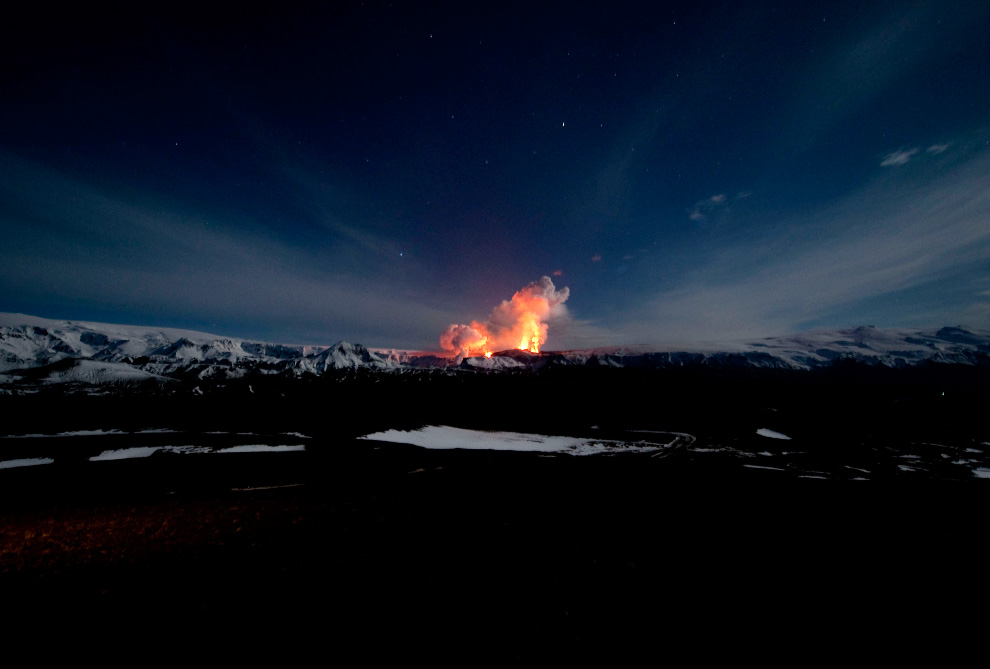
The glow from the ground:

Eyjafjallajokull volcano still erupts dramatically

My initial reaction was actually (in text, to a friend), "omg omg omg omfg geology."


Right now, several airports in Europe (specifically Norway and the UK) are closed because of ash.

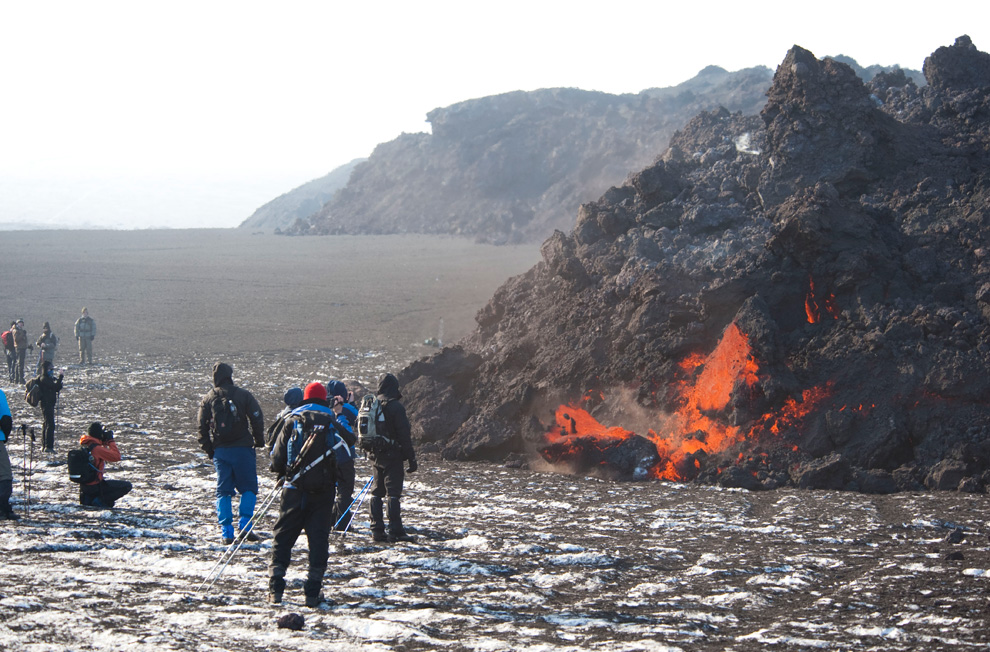
Boston.com's "The Big Picture," one of the best photoblogs on the web, collected pictures of the volcano and its effects today. Some aren't the usual fare, some are especially dramatic, but I think one that most caught my eye was #11 - people in snow gear, standing on dirty snow with ski poles stuck in it, watching flowing lava from a few feet away.


(And for the sake of fun: KCBS said, on twitter: "Why we're just calling it 'a volcano in Iceland'. Try saying this: Mt. Eyjafjallajökull (ay-yah-FYAH'-plah-yer-kuh-duhl)" Wikipedia provides the IPA [ˈɛɪjaˌfjatlaˌjœkʏtl̥]) and an audio clip to unconfuse things.)

Addendum: My friend Ailbhe, in the thick of things, clarifies the current airport closure and flight diversion issues -- "UK, Ireland, Norway, Sweden, Denmark, north Finland, Belgium, north France, the Netherlands in parts" -- and provides a link to a good reason: Volcanic ash destroys airplane engines catastrophically.

Sunday, April 11, 2010

Fascinating Northridge quake coverage

I did spot one major technical/factual mistake, though.


(Have I posted this before, years ago? I should look. But it's a cold, rainy morning, and the dog is asleep on me, and that sounds like a lot of work for today.)

Friday, April 09, 2010

Monday, April 05, 2010

Whoa, earthquake


(Clicking through, of course, gets you to the alt-text for the comic, which you can mouseover for more info, and/or humor.)

Sunday, April 04, 2010

7.2 quake in Baja California today

What scientists are guessing so far:
The fault that triggered the quake was probably located on one of the many faults south of the San Andreas fault, [seismologist Lucy] Jones said. The fault is probably about 40 to 50 miles long, and probably shook for 20 to 30 seconds. The worst shaking would have occurred closest to the fault, said [seismologist Lucy] Jones .

She said scientists would not have enough information to identify the fault until geologists survey the area.

The quake occurred at the junction between two tectonic plates, the Pacific and the North American, that grind against each other through Baja California and California. The quake is probably on a strike-slip fault, which splices through the ground vertically and causes land to move horizontally.


Earthquake damage in Mexicali, Baja California!!!! on Twitpic
A house collapses in on itself in Mexicali.

#terremotoMexicali transformador caido en Manuel Peña y Emil... on Twitpic
A telephone pole pulls wires down in Mexicali

Share photos on twitter with Twitpic
Cars drive over a slightly buckled road in Mexicali

#terremotoMexicali Edificio Excomex. on Twitpic
Commercial buildings crumble slightly in Mexicali

Share photos on twitter with Twitpic
A picnic area shifts dramatically

Share photos on twitter with Twitpic
In Ensenada, a twitterer's laptop sits open in front of gaping wall cracks. (Note Tweetdeck open, perhaps following the news.)

Share photos on twitter with Twitpic
And in El Centro, California, a family's deck lies in their back yard. I thought we had better construction standards than that!

Animation: Dust (or smoke? probably dust) rises from the Mexicali area following the quake

More news is coming in, of course, the "did you feel it?" map is still changing. The quake was only 10 km deep, and I have no doubt we'll hear about more damage than is known so far. As quakes usually are, this one will be another learning experience.

Saturday, April 03, 2010

Science communicators are climate heroes

The general public really needs a good bridge between sometimes complicated science and what we are able to assemble into a useful picture. Clear, simple, fact-rich science communication is essential, good science communicators are priceless anymore.

That's why Dan Satterfield is one of my favorite science communicators. He's direct, smart, and really gets to the point, understanding what his readers need filled in. His most recent blog post really makes that clear to me. Dan goes step by step through not only the reasons why climate change is now scientific reality (with some amazement at the TV weather people who dismiss it as myth), but he also insists its the TV meteorologist's obligation to sort it out for the watchers, for the folks at home whose only exposure to real scientists and balanced science throughout the day might be what they get from their trusty TV weatherguy.

Dan's also just plain good folks. But he's good folks with a sharp mind, and the kind of understanding of his audience (both for his blog, and on TV in Alabama) that teaches rather than preaches, that informs rather than lambasts, that gets the point across in the way we need right now.

He's the kind of science communicator that we can point at as part of the solution to the problem. When you hear people saying, "If only we could communicate science to the masses," point them to Dan's blog, and say, "You mean, like that?"

Friday, April 02, 2010

frazil ice in Yosemite National Park

Steven Bumgardner, who produces Yosemite Nature Notes for the National Park Service, shot some video of "frazil ice" on the Merced River in the park this week, as a cold early spring storm moved across California.


I'd never heard of frazil ice before. Now, because I must look things up compulsively, I'm learning about it. Wikipedia says, "Frazil ice is a collection of loose, randomly oriented needle-shaped ice crystals in water. It resembles slush...," which probably explains why I'm imagining margaritas. And Hajo Eicken at the Geophysical Institute at the University of Alaska, Fairbanks, says
The word frazil means fine spicules or blobs, which gracefully describes the morphology of the crystal. Sea ice growth always begins with frazil ice production, the only true dendritic ice growth phase. Active convection aids sensible heat transport at the ocean surface, thereby super cooling the water and allowing dendritic growth of ice crystals.
This is so cool. Spicules and blobs. Scientific terminology rocks. ("Dendritic," of course, means it's like branches of a tree, like drainage in a river delta, or the shape of a neuron.)

The waterfalls of Yosemite must be delightful just now.

Monday, March 29, 2010

The shaping of the Great Lakes, in an hour

The History Channel's new series, "How the Earth was Made," is mostly just scientific enough for me today, as I'm fighting a low fever, and wanted to stare at something educational without spraining too many neurons. Today I sat down with Hulu and watched an episode about the creation of the Great Lakes.


I knew some of it, such as the glacial history, but hadn't known about the igneous origins of the floor beneath Superior and Ontario. The series is presented in steps, giving evidence for theories (with a bit of the History Channel's typical "but that's not all" and "there's more they didn't know," and "but still, mystery remained" drama), then before each ad, recapping the bits. I appreciated those, it helped me knit the story in stages before going on to the next chapter in the story.

As it turns out, I had no idea how fast Niagara Falls was receding. Do you know? What would you guess? Watch the show and see. I was a tad stunned.

(If the Hulu.com video expires, you can find the video for sale at the History Channel website, with a few clips and full episodes still available.)

Tuesday, March 23, 2010

Do I corrupt my friends or do they corrupt me?


My friend Andy sent me this IM conversation with our friend Paul:
Paul: what is the tensile strength of ROCK AND ROLL quick I need to build this city on it
Andy: The tensile strength of ROCK AND ROLL isn't relevant. Unless you planned to build this city out of it.
Andy: Since you want to build the city *on* Rock and Roll, you'd want to know it's ductility.
Andy: The ductility determines how big the buildings can be without risking sinkage. also, in earthquake zones, low-ductility Rock and Roll would lead to liquifaction, damaging entire regions of the city.

I might be weird, but my friends might be weirder.

Monday, March 22, 2010

Simple Pleasures

Anna's hummingbird (Calypte anna) in flight .... 1 of 2
I just had one of my best bird experiences ever.

I've been paying attention to birds since I was pretty young, but I rarely go out and seek the rare ones. I tend to marvel at what's nearby.

I'm very happy that I got to see a Long-tailed Jaeger once, when it was lost in Mono County, and I was very excited when my husband (decidedly not "a birder") identified a Heerman's Gull along a path a bit west of Monterey Bay Aquarium. But mostly, I revel in the air-coasting of Turkey Vultures, and the way the American Robins fill my yard every March, and the markings of the hundreds of Cedar Waxwings in our local trees (they have a wheezy, tuneless song that is irrelevant given their gorgeous fancy clothes).

I like birds for learning about what they do. I like being able to spot a Western Scrub-jay without glasses on (my glasses, not the jay's) from the way its short swooping glides bring it down from a tree, and I like knowing that we have Black Phoebes because we're near a stream, and they eat bugs (they're at the local dog park for the same reason: flies love those trash cans!), and I like knowing that though the Cooper's Hawks in the neighborhood might be after our chickens, the Red-shouldered Hawks would prefer our pocket gophers. Our garden is grateful for Red-shouldered Hawks.

Today's event was both wonderful for its commonness and what it told me about basic bird behavior, and exhilarating for its sheer wonderfulness.

I was out in the driveway collecting mail, and as usual, our rooster jumped up onto the chicken pen's gate to let me know he was Still The Man. He crowed, and I said "Hi, Rooster," then over my head, in the tulip magnolia tree, a male Anna's Hummingbird began his squeaky territorial chirping. It's fully spring here, so the hummingbirds are nesting, and Anna's Hummingbirds are the kings of the "Gerroff my LAWN!" attitude. (I remember reading an article years ago in Smithsonian magazine describing the hummingbird migration in Arizona. One ranger at a state park told a visitor that if hummingbirds were the size of ravens, it would be unsafe to go outside. When a visitor exclaimed about the belligerent males, "They're so sweet, and so tiny!" he replied, "Yes ma'am, they are tiny.") I noted to myself that the rooster and the hummingbird (also a rooster, in his tiny way) were doing the exact same thing, crowing at the entire world to say that they were indeed The Man.

I couldn't see the hummingbird (no glasses on, and he was in a tree with hummingbird-sized leaves and blossoms), but when he flew over to another tree and began to chirp there, he was obvious. The sun was behind me, and as he moved slightly on his stick-end, he flashed with an almost inorganic magenta, the refractive feathers on his head and gorget throwing photons back at me. And then in a flash, he went up, up, and vanished. I kept my eyes on him as long as I could, but he was, it seemed, nearing escape velocity.

Anna's hummingbirds have the most amazing behavior. Sometimes they swoop down in huge, steep parabolas, making a sort of … ding? bing? musical pop? at the bottom of the dive. They'll fly up, out of sight, then down. I've seen them do this before, from slightly to the side, watched them form the parabola shape. But this time it wasn't quite overhead, I craned my neck up, staring directly at the sky, and the bird quickly became a dot, then disappeared. I knew he had to be diving in a moment, but where?

Then bam! or rather BING! Right over my face! The bugger had dived at my head as I stared and I never saw him. They are very, very fast. From the sound's direction and volume and the sudden bzzt! of wings, I estimate that the vertex of his dive was 2 to 3 feet over my head, and that's close enough.

My heart pounded, I clasped my hands to my chest and said, "Oh BOY!" The little hummingbird was up again, and gone.

It's quite easy to make me happy, really.

Hummingbird Diving In Action from Science News on Vimeo
Photo on top from Alan Vernon.


Imagine being terrified of tiny tremors, for good reason

The recent 5.6 earthquake in Cuba brought down a house in Haiti, and killed two people (at least, so far).


In a country as shaky with aftershocks as Haiti has been, and recent torrential rains making life miserable for people who live under tarps, and still live in gullies (as they have for a long time), imagine if every time the earth shook just a little, you feared for your life. The people under tarps are wetter, but perhaps safer.

Army Street, San Francisco

This is the sort of thing that eats my brain. Someone on livejournal asked where Army Street got its name. It's been 15 years since the name was changed to Cesar Chavez, but a lot of locals still think of it as Army Street, just as there are parts of Martin Luther King Bl. in the east bay that I'll always call Grove Street, just because I was living near there, or knew someone who lived near there, or shopped there, when it was Grove. I have nothing against Chavez or King, it's just that I'm old, and my brain settles into patterns.

At any rate: Now I'll be digging half the day looking for the origins of the name Army Street, because it's the sort of thing I can't let go, and I have things to do, and don't have time.

If you know, please help out here, or on livejournal at the link.

Thanks!


Edited to add:

Found by @silvercrone on twitter:

"As for Army, Loewenstein says it was named by John and Robert Horner, who bought two ranches in the area for $200,000. They named the street to honor the military. There was also a Navy Street, but it did not survive. Its name was changed to a number."

So far, the only relevant Horners I've found were in San Francisco in the 1860s. They did have ranchos, were they the Horners? Probably. Still searching.

Friday, March 19, 2010

geobloggers r us


IMG_1809
Originally uploaded by Ron Schott.
Ron Schott and I agree that there are a lot of great geobloggers out there who are worth your attention.

Ron, however, has made a list.

Check it out. You're unlikely to find that every writer on that list is to your taste, but you're quite likely to discover someone just right for you, who you didn't yet know existed.

Monday, March 15, 2010

Washing into the sea

Madagascar is falling apart geologically and biologically.

Today, Soichi Noguchi posted a gorgeous picture of the mouth of a river in Madagascar, pouring mud into the sea with a design like an abstract painting:

FIRE! Madagaskar. Almost like an oil painting. on Twitpic

Sadly, that mud is flowing off the hillsides with every rainstorm, every one of Madagascar's not-infrequent cyclone hits, and blows off with the wind. Deforestation began in Madagascar with the first European colonization, and the demand for exotic wood (or any wood, eventually), and continued as slopes were cleared for agriculture. Between the general population of Madagascar, with people simply trying to get enough to eat, and shelter, and work, and the corporations driving the agriculture, it will be amazing if Madagascar can keep from dying, biologically, before any sort of control or balance is found.

Sunday, March 14, 2010

Pi Day at the Exploratorium, San Francisco

I love dorks


I'm trying to find a way to connect this to geography, and struggling beyond circular lines of latitude slicing up the earth. I welcome ideas - because I couldn't resist the post.

Tuesday, March 09, 2010

To drink forever alongside Odin

I can't always figure out where Geography ends. Does it include our atmosphere? I think so. Magnetosphere? Why not?


Of course, astronomy fascinates me, too.

At any rate, the auroras are clearly in the zone where astronomy and geography overlap.

Astrospace Now has a great podcast discussing folklore about the auroras.

I've only seen an aurora once, and it was an Aurora Australis. I was at only 32.7 degrees south latitude, in South Australia -- very far north to see them. They oscillated and shimmered like a bright green gossamer curtain. I hope to see the Aurora Borealis this coming spring, when I'll be in Alaska.

(Photo in the creative commons by Chantal Steyn.)

Monday, March 08, 2010

... but not as we know it


Mono lakeshore
Originally uploaded by marymactavish.
Felisa Wolfe-Simon, a geobiologist, thinks Mono Lake may host "...alien life forms, or 'weird life'." She is investigating whether, in the mud or water, there live microbes "whose biological make-up is so fundamentally different from that of any known life on Earth that it may provide proof of a shadow biosphere."

Wow.

I love the Mono Lake basin because it's stunning and fascinating.

The Sierra Nevada rise along its western side.

Panum Crater, to the south, is a small volcanic cone a few hundred years old. When you hike up into it, first you walk over crunchy pumice, then over pieces of obsidian that tinkle underfoot like broken glass, making the thought of a stumble slightly nerve-wracking.

I once saw a Long-tailed Jaeger in a freshwater pond just north of Mono Lake. It's a pelagic bird that was lost ... or interested. Many species of bird feed on the brine flies at the edge of the lake. Eighty-five percent of California Gulls (the species, not the geographically-placed) breed here.

And Mono Lake plays an important role in the history of the environmental movement, its healthy future being the impetus for the Mono Lake Committee, one of the most effective and inclusive grassroots environmental movements in California.

But now, the possibility of parallel evolution? arsenic-based life? Mono Lake just gets cooler.

Sunday, February 28, 2010

At least the birds got a few extra mud-critters for lunch

This covers the first two-thirds or so of a tsunami surge cycle at Point Loma, in San Diego. A small tsunami sloshed around the entire Pacific Ocean on February 27, 2010, in response to an 8.8 earthquake in Chile.

As much as that this video is nearly ten minutes long, I wish it had been longer. I'm not sure I'd want it edited, either -- I like the everydayness of it, the way people are talking to each other, and their wonder at the water.

I'm working on a bigger post about Chile, which I'll post in 12 hours or so.

Wednesday, February 24, 2010

The Mimic Octopus


Mimic Octopus
Originally uploaded by Daniel, Daniel Kwok.
Like everyone, I sometimes have days on which I do little but watch octopus videos:


This species, the Indonesian mimic octopus, was just discovered twelve years ago. It is fabulous.


It's known to mimic at least 13 different animals or corals, some of them deadly poisonous, though scientists admit they don't always know what they're seeing.


They're lost due to habitat degradation, fishing bycatch, recently even the pet industry.


It saddens and sometimes horrifies me that we can be doing such damage to species that weren't identified by scientists until our current crop of high school students was first learning to read.


I don't eat octopus, and I do what I can to help protect its habitat and the creatures in it. Biodiversity is essential, no species is completely expendable, but octopuses are just too damned cool to lose.


Monday, February 22, 2010

Frankly, I'm a little disappointed

Matt Rosenberg pointed out on twitter that the Einstein geography quote I posted (which I'd found on a university's geography department homepage, so trusted without thinking) was debunked: ".... this quote was actually written by Duane F. Marble, Professor of Geography at Ohio State University." The rest of the story is at the link.

I'm a little disappointed. It would have been an awesome thing for Einstein to have said.

Winter topography

As I mentioned, Mr.President, Grand Canyon is breathtaking! on Twitpic


The Grand Canyon from the ISS, by Soichi Noguchi

"As I mentioned, Mr.President, Grand Canyon is breathtaking!"

Soichi Niguchi is way up on my list of all time favorte astronauts, if for no reason other than his sheer delight in photographing the Earth.

Sunday, February 21, 2010

Geography's hard, let's do physics


it's a small world
Originally uploaded by frerieke.
"As a scholar, I wanted to study Geography. However, upon examination of the subject matter, I found it too difficult and reluctantly turned my attention to the study of Physics" - Albert Einstein


(possible correction)

Wallpapering with rocks and dirt

A huge chunk of my time for the past couple of days has been spent reinstalling Windows. It turns out that one can save a lot of time doing it right the first time --who knew? But I have a cranky old laptop, and only moderate computer skills (and a life, with other things to do), so I've been stuck with my old Treo for internet use for awhile.

While I was looking for interesting replacement wallpaper (eagerly anticipating a switch either to a Mac or to Windows 7, so I can rotate wallpaper -- decisiveness isn't my forte, I'd rather rotate nice wallpaper than have to decide) I stumbled on this neat blog I'd never seen before:
Geological Musings in the Taconic Mountains and today's relevant post, Geology Desktop Images.

I haven't yet poked around on it (still setting up my laptop) but will as soon as I've truly up and running.

Monday, February 15, 2010

Massive, impressive, slow-moving rockslide in Italy


Found at Rockglacier via Callan Bentley and Chris Rowan (or Mountain Beltway and Highly Allochtonous)

I don't speak Italian, but I imagine he's saying, "Holy cow, it's flowing like lumpy pudding!" Anyone have other details?

Wednesday, February 10, 2010

Snowing on blog ideas, or something

The internet is filling up with time-lapse snow photos from the east coast!


(Details on click through.)

I've got a whole list of geographile-seeds on my desktop here, and one hard post I'm working on, I want to explain the difference between climate and weather, and how climate change (or even global warming, gasp) could explain heavy-snow winters. I'm also working on the geography of the setting of one of my favorite book series, and exploring the relationship between HAARP and the Haiti quake - or the lack thereof.

What do you want to read about?

Sunday, February 07, 2010

I love David Attenborough almost as much as I love sloths

snowpocalypse

The east coast of the United States is waking up to a world of snow today, after a record-breaking snowstorm.

A couple of people have posted a link to this image on twitter:


There have been no credits for it, nor precise locations, from what I can find. I'd love more information, both for credit and geographic specificity, if you know of any.

Friday, February 05, 2010

Sakurajima blowing ash


Sakurajima at Sunset
Originally uploaded by KimonBerlin.
This post will be dated eventually, but at least right this minute, I can see ash erupting heavily out of the summit of Sakurajima on the live webcam: link here, in English, more languages available with clicky things at top right.

Sakurajima is a composite volcano, and used to form an island in a caldera, but in the past century, eruptive growth has joined it to the mainland.

Big Brothers


Big Brothers
Originally uploaded by Michæl Paukner.
Busy day, without anything organized to write about. Thus, an image - but a neat one. :D

Sunday, January 31, 2010

Thursday, January 28, 2010

Manzanita mandala


Manzanita
Originally uploaded by robherr.
I've written before about how much I love manzanita.

I want to learn to discern the various California species, but Pete Veilleux over at East Bay Wilds, who really knows his local native stuff, says it's a difficult task.

Among my classes this term are a couple or three that focus on local natural history. That should help.

Martin pointed out this gorgeous circle of manzanita leaves from Rob Herr, at Flickr. (He granted me permission to use the photo, it's not in the creative commons realm.)

The leaves are so beautiful and special. They're sclerophyllic, tough and a little leathery, to survive the hot, dry summers of their western habitats. The leaves chemically change soil to make it harder for competing plants to grow. And the colors, oh: they start so delicately green, and toughen to a darker green, turn reddish, then before they're gone, it's as if they self-immolate, without flames, they just dry and blacken. (They sometimes fall off before this stage, too, but it's weird, like someone's lit them.)

Their angle on the plant maximizes sun exposure when the sun is less direct and drying, in the morning and late afternoon, but minimizes it at midday, conserving moisture.

I love manzanita. Later, I'll write about the fire ecology around it and chaparral, and its magical bark, and what I want to do with the wood.

Howard Zinn, RIP - and he will


Howard Zinn
Originally uploaded by teeping.
"We don't have to wait for some grand utopian future. The future is an infinite succession of presents, and to live now as we think human beings should live, in defiance of all that is bad around us, is itself a marvelous victory." -- Howard Zinn, August 24, 1922 – January 27, 2010

Howard Zinn was a great historian. I encountered him in high school, and if he did nothing else for me, he encouraged me not to take everything my textbooks said as the whole truth and end of the story, but to ask questions and think beyond curriculum. I've applied that to most of what I've read in academia and the media in the decades since.

Monday, January 25, 2010

*knockknock*


checking the weather
Originally uploaded by dave~.
Lately I've been wanting to know more about who's reading Geographile, and why.
I don't get a lot of comments, nor do I troll for them. I'd like to make the blog a little more interactive, but I avoid all those "get more comments" web pages and similar, I'm mostly here for myself. But I know there are readers.

I don't use site metrics. I don't beg for comments. So how do I find out who's here?

I must not have had my creativity hat on, because when I saw this Coyote Crossing post, it was so obvious.

Chris said:
If you’ve been reading Coyote Crossing for a while and never said anything, or even i this is the first time you’ve been here, consider this your formal invitation to introduce yourself, say hello, offer advice or complaints, or just generally mark a little bit of territory.

Go ahead and substitute Geographile for Coyote Crossing, except, in the marking territory category, I must say: Please don't pee on my blog. Thank you.

And while you're at it, check out Coyote Crossing, too. It's insightful, full of good information, and just plain interesting.

Sunday, January 24, 2010

ferocious weather

Well - not really ferocious. We just so rarely get tornados, that when we do, it's a bit startling.


Our tornados in California are almost never as high as 2 on the Fujita scale, and are usually 0 or 1. This one touched down, but well away from where it could do damage.

I keep thinking, "Now I'm going to write about this wacky week of weather," but then we keep having more days of it, and I think, "As soon as it's done ..." Rain is in the forecast, but it looks like the wildness is calming down. Perhaps it's time.

Thursday, January 14, 2010

Haiti - hoping for recovery, in context


Peacekeeping - MINUSTAH
Originally uploaded by UNDP Global.
When I was little, one of my favorite books was The Stone*. I don't remember the details of it, I just remember the imagery, learning about Heart of Palm, and children's relationships with elders, and the life of a boy in what seemed to me a poor, but idyllic, countryside.

Mind you, it was set back when Haiti still had trees, but still: Life there was anything but as idyllic as the book showed, even then.

The misery wasn't shared in a children's novel, of course. The book made me want to live in Haiti one day. I became interested in French, and more than that in Creole. I imagined wandering jungles and listening to birds sing.


I only recently realized how much that book became most of my rose-colored knowledge about Haiti.

In adulthood, I've known that people thought it worthwhile to float hundreds of miles across open water in rafts to escape Haiti. I've known about Papa Doc and Baby Doc being horrible, fearsome dictators, and that the US somehow propped them up, but without detail.

I've known that Port-au-Prince was desperately crowded and poor,


that slums in Haiti and many towns have open gutters running down the middle of the road to carry raw sewage, and that children there were desperately hungry.


But I realize now with some shame that I had no idea of what the history was really like, Haiti's ancient legacy of debt, and how, between historically oppressive France, and the callous policies of the US, and what seems to be like near-disdain from the IMF, Haiti hasn't been able to get a break at all.

Add onto that its recent hurricanes, its overpopulation and environmental exploitation leading to deforestation and mud sliding, and now, the unlocking of a 200-year-old fault bringing shoddily-built Port-au-Prince to its knees in a pile of concrete dust and bodies, and I wonder how - or whether - they'll recover from their current situation.

My friend Meredith posted a link to a story with a brief history of Haiti, by Alex von Tunzelmann, from the London Sunday Times, May 17, 2009.
Just why is Haiti in such a dire situation, so much worse than any other country in the Americas, and as bad as anywhere on Earth? Some blame the United Nations. Some blame the Americans. Some have theories about the collision of global warming with global capitalism. All are careful to point out that the Haitian elite deserves its reputation for being greedy, negligent and kleptocratic. "I think the Haitian people have been made to suffer by God," Wilbert, a teacher, tells me, “but the time will come soon when we will be rewarded with Heaven."

There's a full summary of Haitian history at that link. Please click through and read it when you have a minute. In Wilbert's words, I hear Pat Robertson giggling. Pathetic slime rat.

I know Haiti needs help now more than ever before (except, perhaps, when they were trying to get out from under the French initially - what might be different now?) but I have no idea what we need to do. I'd start by saying that the US and other countries need to seriously consider more refugee status for Haitians. We need to help within the country more, but they've been a black hole for charity dollars in the past, with their kleptocracy and corruption. Doctors Without Borders, Oxfam, the smaller organizations are doing what they can with non-financial help, but in that system, how much can they do?

I'm overwhelmed at the thought. "How to fix it" is not my area of expertise, or they'd have called me long ago. Does anyone really know?

One thing I'm sure of: Knowledge is power. Learning about the history of countries like Haiti (and Iraq, and Israel/Palestine, and Laos, and Bolivia, and even the US) correctly, unsanitized, places current problems in context, so that solutions can be built from a base of fact and strength, rather than on a pile of rubble. We need to make sure other people see and read that story, and others like it.

*Searching now, I can't find The Stone. I don't remember who wrote it. It was about a boy named, I think, Peter or Pierre, and I think he lived with his grandmother, and loggers were cutting the palms, killing them, killing their hearts - so heart of palm, which was loved and precious, could not be harvested.


Tuesday, January 12, 2010

Port au Prince from the hills above it, today


How terrifying to see from above ... but far worse from the streets below.

sfgate.com has a great list of organizations who need your help so that they can help the people of Haiti. It looks like Doctors Without Borders lost their surgical facilities - and Haiti needs them right now. They're on the list. UNICEF needs you, too, as does the Red Cross.

Haiti is already the most impoverished nation in the western hemisphere, and hasn't yet recovered from last year's hurricanes, let alone the decades of political upheaval and violence. There's only so much we can do ... but that's better than nothing.

Monday, January 11, 2010

One year in two minutes

Eirik Solheim compressed a year into 120 seconds of video, to share the seasonal changes he observes from his balcony.


There is a point at which I think I can see the trees grow.

He explains his process in his blog, so you can do it to. Let me know when you're done, so I can post it here.

Sunday, January 10, 2010

Arctostaphylos is love


Finished Back Piece
Originally uploaded by savor_soaps.
I've been going to get a tattoo for ages, and I've only wanted Marie Wadman at Diving Swallow to do it. She's expensive, but VERY GOOD and sympatico with what I want.

I'd been planning on Douglas irises and/or California poppies, two of my favorite wildflowers. But I'm also in love with manzanita. One of my goals this year is to learn to discern each species of manzanita in the greater bay area.

I want California native plants because this is home, where my parents grew up, and I grew up, and my Mom was born, and Grandpa was born, and his parents were born ... back to the 1850s. And we're not beach people or mountain people, we're coastal hills people and sagebrush people and foothills people. My bones are partially made of manzanita wood, I think.

Eventually, my only wishlist item will be a link to a jar where folks can throw pennies at a tattoo fund. Then, when it's full, I'll contact Marie as per her instructions (ping her in fall, she'll get back to you later as she fills up her entire coming year's calendar) and plan my first tattoo.

(Here's the whole manzanita tattoo set from savor_soaps on flickr. I love this.)

Frozen Earth

A walk around Higham, Derbyshire, UK, by Grace Elliot. I assume this video was made just this week, during the Big Freeze. (It was uploaded yesterday.)


This makes me want to explore parts of my world more like this - not in video, but images ... lots of them. It feels more like stopping to look.

Google maps has a satellite view clear enough for you to follow her around, if you want a little fun.

Saturday, January 09, 2010

Or maybe they're going to Oregon because it's what Californians do


Curious Sea Lion
Originally uploaded by Dave Schumaker.
I like to write Geographile posts that, if not brief, are either heartfelt and eloquent, or well-researched. Brief ones can be neither. However, this one also is neither. It is ranty and annoyed.

I'm recovering from the flu, and what I want to do, really, is to go play flash games and have a beer, or maybe have another Sudafed (the real stuff) and go to bed.

But instead, there was this earthquake today, which was exciting. And besides all the Jesus Is Coming and similar posts on twitter, the bad science started coming out.

See, last October, the ubiquitous, numerous, smelly, but cute California sea lions at Pier 39 in San Francisco started leaving the area. Then more left, and soon, people were wondering what had become of our sea lions, which aren't historically massed there, but have been as of the past few years.

Within the past couple of weeks, they were found, up with the Steller sea lions and other marine mammals along the Oregon Coast, and at Sea Lion Caves, perhaps due to shifting temperatures, those perhaps due to our currently strengthening El Niño pattern, because that's where their food went. (Yes, there's still a lot of "perhaps," but this was a puzzle until recently, and is coming together.)
.
And of course, because it seemed "suddenly," folks on Twitter are saying, "They knew the quake was coming." (At least one of these twitterers might even be from the bay area or elsewhere in earthquake country, or perhaps sea lion country. Or not.)

But this is not sudden, and there are explanations:

1) The sea lions started leaving in October.
2) Recent, pre-today research suggests that their being found in SW Oregon reflects temperature changes in the ocean off the coasts of California and Oregon, and the food the sea lions prefer is following the temperatures they like. The sea lions are following fish. (Some aren't. Some seem to be hanging out at the Farralons for squid. But many went to the waters off the coast of SW Oregon for fish.)


Now here's the thing:

According to Google maps, from Florence, Oregon, where Sea Lion Caves is, to Ferndale, California, the nearest town to today's quake epicenter, is 285 miles. From San Francisco to Ferndale is 262 miles, by straighter roads. So let's call the quake area halfway in between there. (Yes, I know the sea lions don't drive. But I'm ballparking things here.)

Why would marine mammals leave in October (and later, but still) to swim through where a quake is coming, and end up just as far on the other side ... because they knew a quake was coming?

sealionquake1

It's not like I expect sea lions to have logic, but c'mon: Why? Why not go, oh, to Santa Barbara, the other direction? Why go to all that effort to end up the same distance from the quake anyhow?

And why leave San Francisco when today's quake was barely felt at all there? It wouldn't gain them any advantage.

quakesealion2

Folks are saying, "Animals do strange things." Sure. Sometimes they do. But if you're going to make a wacky connection, at least come up with a good enough story to support it.

Dear people who were kind enough to discuss this with me on twitter today:
I don't mean to be totally dissing you. I am open-minded about, say, that there are aspects of quakes that animals can sense but we don't, and there are noises they can hear that we can't. But look: The idea that sea lions would leave the San Francisco area for Oregon, passing through an area where a quake is going to happen weeks in the future, to end up the same distance on the other side, when there's no good reason for sea lions to care, makes no sense on any level, not even if I were to open my mind so far my brain falls right out.

Wednesday, January 06, 2010

Arctostaphylos pajaroensis 'Warren Roberts' - Warren Roberts Pajaro Manzanita

One of my goals this year is to learn to discern every single manzanita species within a couple of hours of my house. They're different, they fit different niches. They're mostly sclerophylls, and healthiest with wildfire every couple of decades. They control the chemistry underneath them for their own best health. They have the most beautiful wood, and the most fairy-like little flowers, and I am in love with them. They are one of the plants that screams "California" to me, the California I grew up with and love.

Monday, December 21, 2009

early geography


rainCIMG8739
Originally uploaded by marymactavish.
When I was at my youngest, the scale of the world, and what went on over the earth, never occurred to me. I fell asleep on long car trips, so I thought we lived relatively near the bay area, as I always woke up as we crossed the Carquinez Strait. I actually remember many of the various stages of geographic awareness I passed.

When we got air conditioning in our car, and didn't have to drive down the valley at 2 am in the roasting summertime, I learned how far away we were from the bay area, as I was awake for the ride.

And Robert Louis Stephenson taught me to think about what was going on elsewhere, in terms of shared experience. Steady, cold rain like today's reminds me of his poem, "Rain." It's so simple:

THE RAIN is raining all around,
It falls on field and tree,
It rains on the umbrellas here,
And on the ships at sea.


Oddly, re-reading that, I notice that I remembered it differently. Until now, I remembered, "It rains on houses in Japan/And on the ships at sea." I wonder why. Was I looking at pictures or reading books about Japan, then? About houses or umbrellas in Japan?

Hm.

This sort of thing, though, colored my geographic learning, and I think it's valuable in any child's learning, to have literature that isn't all about morals and lessons, but also about images, and places, and shared experience, and how things were different back then, and about how we're not the only people in the world, and our experience is not the only experience, and that there are things we will all share, and that there are things that we might never relate to.

Saturday, December 19, 2009

The Universe, and the Tibetan Plateau


P1010283
Originally uploaded by yingzhao.
This new video from the American Museum of Natural History is making the rounds. It's a stunning digital visualization of the known universe with proper sizes, distances, scales. I'm not sure exactly how they increase speed of change. It definitely changes, as it takes a few seconds to travel a few light seconds, then not long after, a few seconds to travel many light years, or a few million light years. It had to be thus, but I did lose a sense of scale eventually, even with the incredible illustrations.

I had no idea, for instance, how much completely unmapped space there is. Why is that? I can see it being hard to map past the center of the Milky Way, but couldn't tell in which directions we're yet unmapped, and why -- could be be that hard to map in the opposite direction from the center? Are the stars densely packed that direction, for far enough to make it opaque for us?


Of the whole video, though, my favorite part was tipping past the Himalaya to see the lakes of the Tibetan Plateau. I had no idea how lake-rich the area is. I knew that it was sparsely populated, that big quakes there can go almost unreported except by instruments, that there are thousands of square miles with no roads. But the lakes just caught my attention: Look at all this gorgeous water. What's it like there? Who lives there? What do they do?

It turns out google and flickr both had answers for me.

Wednesday, December 16, 2009

lunacy, really

According to Phil Plait, at least 90% of all murders happen within a week of either the new moon (like right this minute) or the full moon.

Amazing, really, when you think about it.

Photo by JPStanley

via Creative Commons search

on Flickr.

Saturday, December 12, 2009

Mountain of Ghosts - Algeria - November 2005


"There's enough sand in the Sahara to cover most of North Africa." - Martin DeMello, December 2009

It's really amazing what you learn on the internet, these days.

Thursday, December 10, 2009

Geologists rock!

Might be that a certain road crew should take geologist Vanessa Bateman out for coffee.

The video gets interesting at about 1:00ish.


I'm really not sure I wouldn't have flipped the hell out, watching this. Then I'd have asked Bateman to follow me around and be my body guard.

(via agweb, thanks to Silver Fox for the story, thanks to @caroldn for the new title)

Tuesday, December 01, 2009

Excerpts of the President's Address to the Nation, Dec. 1, 2009 in a tag cloud

So ... if we were to pull out *this week,* what would happen in Afghanistan over the coming year?

Tuesday, November 24, 2009

The Anthropology Song

Anthropology is close enough to cultural geography to count, for me. I like this song enough that I played it in the background while I did other things a few times today.

Saturday, November 21, 2009

What if Earth had rings like Saturn?


I don't want to interrupt the loveliness of this idea, but there are bits from the video and the comments that I want to note:

Someone commented that this might make places under the rings where it was permanently dark. But because the earth is tilted on its axis and the sun appears to move north and south through the sky seasonally, so would the shadow move. But it's likely some places (the equator, generally everywhere between the tropics) would get some level of shade from the rings. The layer is very thin; aside from under the rings at equinox, there would be plenty of bright sun. Would there be enough insolation change to affect climate? Probably. But given the scenario, I expect the earth would have evolved this way, it's not like it would be a change from how things are now.

The person who made the animation seems to have designed it for equinox. Seasonal variations aren't addressed at all.

The theoreticals (e.g. one commenter's note that this would affect satellites) are irrelevant to me: It's beautiful.

Saturday, November 14, 2009

Accra - A C C R A

I don't know the capital of every country in the world, nor do I think I *should* - but this is still fun:


When I was little, and couldn't sleep, Mom suggested I list every single state in the US, alphabetically. If I ever realized I'd missed one, I had to go back and start from the beginning. I don't think I made it to Wyoming.

I found myself, as I passed San Bruno Mountain today, where the endangered Mission Blue butterfly lives, "There are Mission Blues on San Bruno Mountain, but the California dogface butterfly is our state butterfly. Why do I know that? I don't know. I just do."

It's the sort of useless thing that helps me paint a picture of the world when people talk about it. It's a piece of the whole puzzle.

Thursday, November 12, 2009

Africa from Europe on Google Streetview

From Google Sightseeing


How cool is that? That is very cool.

We're fostering a tiny puppy, switching the garden over into fall mode, trying to get our house in order, and I'm finishing a semester at school. This is Geography Awareness Week, and I think there will be a post about that before the week is up.

Tuesday, October 20, 2009

sense of place - Oakland Hills Fire


Oakland Hills Fire -- after
Originally uploaded by marymactavish.
For some reason, as I go through my old photos, the fire photos are really affecting me. Even before I noticed them in my stack of "photos to scan," I was noticing again how the hills have grown up thicker with eucalyptus than before, and the plan to places houses farther apart and make roads wider is barely there. And I might be wrong, but I think that Oakland never did get around to making its fire hydrants compatible with the hoses of surrounding towns' fire departments.

But anyway: I'm thinking of it, eighteen years later.