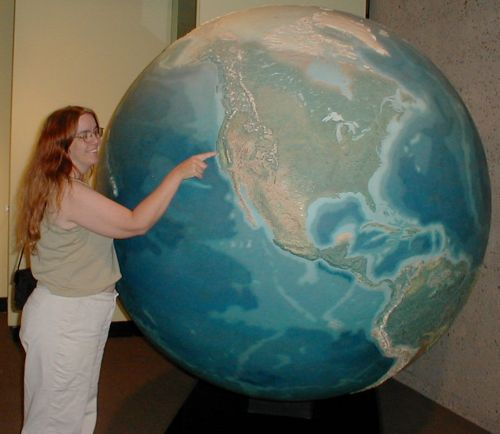
I did spot one major technical/factual mistake, though.
(Have I posted this before, years ago? I should look. But it's a cold, rainy morning, and the dog is asleep on me, and that sounds like a lot of work for today.)
Showing posts with label earthquakes. Show all posts
Showing posts with label earthquakes. Show all posts
Sunday, April 11, 2010


Monday, March 22, 2010
Imagine being terrified of tiny tremors, for good reason
The recent 5.6 earthquake in Cuba brought down a house in Haiti, and killed two people (at least, so far).
In a country as shaky with aftershocks as Haiti has been, and recent torrential rains making life miserable for people who live under tarps, and still live in gullies (as they have for a long time), imagine if every time the earth shook just a little, you feared for your life. The people under tarps are wetter, but perhaps safer.
In a country as shaky with aftershocks as Haiti has been, and recent torrential rains making life miserable for people who live under tarps, and still live in gullies (as they have for a long time), imagine if every time the earth shook just a little, you feared for your life. The people under tarps are wetter, but perhaps safer.
Thursday, January 14, 2010
Haiti - hoping for recovery, in context
When I was little, one of my favorite books was The Stone*. I don't remember the details of it, I just remember the imagery, learning about Heart of Palm, and children's relationships with elders, and the life of a boy in what seemed to me a poor, but idyllic, countryside.
Mind you, it was set back when Haiti still had trees, but still: Life there was anything but as idyllic as the book showed, even then.
The misery wasn't shared in a children's novel, of course. The book made me want to live in Haiti one day. I became interested in French, and more than that in Creole. I imagined wandering jungles and listening to birds sing.

I only recently realized how much that book became most of my rose-colored knowledge about Haiti.
In adulthood, I've known that people thought it worthwhile to float hundreds of miles across open water in rafts to escape Haiti. I've known about Papa Doc and Baby Doc being horrible, fearsome dictators, and that the US somehow propped them up, but without detail.
I've known that Port-au-Prince was desperately crowded and poor,

that slums in Haiti and many towns have open gutters running down the middle of the road to carry raw sewage, and that children there were desperately hungry.

But I realize now with some shame that I had no idea of what the history was really like, Haiti's ancient legacy of debt, and how, between historically oppressive France, and the callous policies of the US, and what seems to be like near-disdain from the IMF, Haiti hasn't been able to get a break at all.
Add onto that its recent hurricanes, its overpopulation and environmental exploitation leading to deforestation and mud sliding, and now, the unlocking of a 200-year-old fault bringing shoddily-built Port-au-Prince to its knees in a pile of concrete dust and bodies, and I wonder how - or whether - they'll recover from their current situation.
My friend Meredith posted a link to a story with a brief history of Haiti, by Alex von Tunzelmann, from the London Sunday Times, May 17, 2009.
There's a full summary of Haitian history at that link. Please click through and read it when you have a minute. In Wilbert's words, I hear Pat Robertson giggling. Pathetic slime rat.
I know Haiti needs help now more than ever before (except, perhaps, when they were trying to get out from under the French initially - what might be different now?) but I have no idea what we need to do. I'd start by saying that the US and other countries need to seriously consider more refugee status for Haitians. We need to help within the country more, but they've been a black hole for charity dollars in the past, with their kleptocracy and corruption. Doctors Without Borders, Oxfam, the smaller organizations are doing what they can with non-financial help, but in that system, how much can they do?
I'm overwhelmed at the thought. "How to fix it" is not my area of expertise, or they'd have called me long ago. Does anyone really know?
One thing I'm sure of: Knowledge is power. Learning about the history of countries like Haiti (and Iraq, and Israel/Palestine, and Laos, and Bolivia, and even the US) correctly, unsanitized, places current problems in context, so that solutions can be built from a base of fact and strength, rather than on a pile of rubble. We need to make sure other people see and read that story, and others like it.
*Searching now, I can't find The Stone. I don't remember who wrote it. It was about a boy named, I think, Peter or Pierre, and I think he lived with his grandmother, and loggers were cutting the palms, killing them, killing their hearts - so heart of palm, which was loved and precious, could not be harvested.


Mind you, it was set back when Haiti still had trees, but still: Life there was anything but as idyllic as the book showed, even then.
The misery wasn't shared in a children's novel, of course. The book made me want to live in Haiti one day. I became interested in French, and more than that in Creole. I imagined wandering jungles and listening to birds sing.
I only recently realized how much that book became most of my rose-colored knowledge about Haiti.
In adulthood, I've known that people thought it worthwhile to float hundreds of miles across open water in rafts to escape Haiti. I've known about Papa Doc and Baby Doc being horrible, fearsome dictators, and that the US somehow propped them up, but without detail.
I've known that Port-au-Prince was desperately crowded and poor,
that slums in Haiti and many towns have open gutters running down the middle of the road to carry raw sewage, and that children there were desperately hungry.
But I realize now with some shame that I had no idea of what the history was really like, Haiti's ancient legacy of debt, and how, between historically oppressive France, and the callous policies of the US, and what seems to be like near-disdain from the IMF, Haiti hasn't been able to get a break at all.
Add onto that its recent hurricanes, its overpopulation and environmental exploitation leading to deforestation and mud sliding, and now, the unlocking of a 200-year-old fault bringing shoddily-built Port-au-Prince to its knees in a pile of concrete dust and bodies, and I wonder how - or whether - they'll recover from their current situation.
My friend Meredith posted a link to a story with a brief history of Haiti, by Alex von Tunzelmann, from the London Sunday Times, May 17, 2009.
Just why is Haiti in such a dire situation, so much worse than any other country in the Americas, and as bad as anywhere on Earth? Some blame the United Nations. Some blame the Americans. Some have theories about the collision of global warming with global capitalism. All are careful to point out that the Haitian elite deserves its reputation for being greedy, negligent and kleptocratic. "I think the Haitian people have been made to suffer by God," Wilbert, a teacher, tells me, “but the time will come soon when we will be rewarded with Heaven."
There's a full summary of Haitian history at that link. Please click through and read it when you have a minute. In Wilbert's words, I hear Pat Robertson giggling. Pathetic slime rat.
I know Haiti needs help now more than ever before (except, perhaps, when they were trying to get out from under the French initially - what might be different now?) but I have no idea what we need to do. I'd start by saying that the US and other countries need to seriously consider more refugee status for Haitians. We need to help within the country more, but they've been a black hole for charity dollars in the past, with their kleptocracy and corruption. Doctors Without Borders, Oxfam, the smaller organizations are doing what they can with non-financial help, but in that system, how much can they do?
I'm overwhelmed at the thought. "How to fix it" is not my area of expertise, or they'd have called me long ago. Does anyone really know?
One thing I'm sure of: Knowledge is power. Learning about the history of countries like Haiti (and Iraq, and Israel/Palestine, and Laos, and Bolivia, and even the US) correctly, unsanitized, places current problems in context, so that solutions can be built from a base of fact and strength, rather than on a pile of rubble. We need to make sure other people see and read that story, and others like it.
*Searching now, I can't find The Stone. I don't remember who wrote it. It was about a boy named, I think, Peter or Pierre, and I think he lived with his grandmother, and loggers were cutting the palms, killing them, killing their hearts - so heart of palm, which was loved and precious, could not be harvested.
Tuesday, January 12, 2010
Port au Prince from the hills above it, today
How terrifying to see from above ... but far worse from the streets below.
sfgate.com has a great list of organizations who need your help so that they can help the people of Haiti. It looks like Doctors Without Borders lost their surgical facilities - and Haiti needs them right now. They're on the list. UNICEF needs you, too, as does the Red Cross.
Haiti is already the most impoverished nation in the western hemisphere, and hasn't yet recovered from last year's hurricanes, let alone the decades of political upheaval and violence. There's only so much we can do ... but that's better than nothing.
Saturday, January 09, 2010
Or maybe they're going to Oregon because it's what Californians do
I like to write Geographile posts that, if not brief, are either heartfelt and eloquent, or well-researched. Brief ones can be neither. However, this one also is neither. It is ranty and annoyed.
I'm recovering from the flu, and what I want to do, really, is to go play flash games and have a beer, or maybe have another Sudafed (the real stuff) and go to bed.
But instead, there was this earthquake today, which was exciting. And besides all the Jesus Is Coming and similar posts on twitter, the bad science started coming out.
See, last October, the ubiquitous, numerous, smelly, but cute California sea lions at Pier 39 in San Francisco started leaving the area. Then more left, and soon, people were wondering what had become of our sea lions, which aren't historically massed there, but have been as of the past few years.
Within the past couple of weeks, they were found, up with the Steller sea lions and other marine mammals along the Oregon Coast, and at Sea Lion Caves, perhaps due to shifting temperatures, those perhaps due to our currently strengthening El Niño pattern, because that's where their food went. (Yes, there's still a lot of "perhaps," but this was a puzzle until recently, and is coming together.)
.
And of course, because it seemed "suddenly," folks on Twitter are saying, "They knew the quake was coming." (At least one of these twitterers might even be from the bay area or elsewhere in earthquake country, or perhaps sea lion country. Or not.)
But this is not sudden, and there are explanations:
1) The sea lions started leaving in October.
2) Recent, pre-today research suggests that their being found in SW Oregon reflects temperature changes in the ocean off the coasts of California and Oregon, and the food the sea lions prefer is following the temperatures they like. The sea lions are following fish. (Some aren't. Some seem to be hanging out at the Farralons for squid. But many went to the waters off the coast of SW Oregon for fish.)

Now here's the thing:
According to Google maps, from Florence, Oregon, where Sea Lion Caves is, to Ferndale, California, the nearest town to today's quake epicenter, is 285 miles. From San Francisco to Ferndale is 262 miles, by straighter roads. So let's call the quake area halfway in between there. (Yes, I know the sea lions don't drive. But I'm ballparking things here.)
Why would marine mammals leave in October (and later, but still) to swim through where a quake is coming, and end up just as far on the other side ... because they knew a quake was coming?

It's not like I expect sea lions to have logic, but c'mon: Why? Why not go, oh, to Santa Barbara, the other direction? Why go to all that effort to end up the same distance from the quake anyhow?
And why leave San Francisco when today's quake was barely felt at all there? It wouldn't gain them any advantage.

Folks are saying, "Animals do strange things." Sure. Sometimes they do. But if you're going to make a wacky connection, at least come up with a good enough story to support it.
Dear people who were kind enough to discuss this with me on twitter today:
I don't mean to be totally dissing you. I am open-minded about, say, that there are aspects of quakes that animals can sense but we don't, and there are noises they can hear that we can't. But look: The idea that sea lions would leave the San Francisco area for Oregon, passing through an area where a quake is going to happen weeks in the future, to end up the same distance on the other side, when there's no good reason for sea lions to care, makes no sense on any level, not even if I were to open my mind so far my brain falls right out.

I'm recovering from the flu, and what I want to do, really, is to go play flash games and have a beer, or maybe have another Sudafed (the real stuff) and go to bed.
But instead, there was this earthquake today, which was exciting. And besides all the Jesus Is Coming and similar posts on twitter, the bad science started coming out.
See, last October, the ubiquitous, numerous, smelly, but cute California sea lions at Pier 39 in San Francisco started leaving the area. Then more left, and soon, people were wondering what had become of our sea lions, which aren't historically massed there, but have been as of the past few years.
Within the past couple of weeks, they were found, up with the Steller sea lions and other marine mammals along the Oregon Coast, and at Sea Lion Caves, perhaps due to shifting temperatures, those perhaps due to our currently strengthening El Niño pattern, because that's where their food went. (Yes, there's still a lot of "perhaps," but this was a puzzle until recently, and is coming together.)
.
And of course, because it seemed "suddenly," folks on Twitter are saying, "They knew the quake was coming." (At least one of these twitterers might even be from the bay area or elsewhere in earthquake country, or perhaps sea lion country. Or not.)
But this is not sudden, and there are explanations:
1) The sea lions started leaving in October.
2) Recent, pre-today research suggests that their being found in SW Oregon reflects temperature changes in the ocean off the coasts of California and Oregon, and the food the sea lions prefer is following the temperatures they like. The sea lions are following fish. (Some aren't. Some seem to be hanging out at the Farralons for squid. But many went to the waters off the coast of SW Oregon for fish.)
Now here's the thing:
According to Google maps, from Florence, Oregon, where Sea Lion Caves is, to Ferndale, California, the nearest town to today's quake epicenter, is 285 miles. From San Francisco to Ferndale is 262 miles, by straighter roads. So let's call the quake area halfway in between there. (Yes, I know the sea lions don't drive. But I'm ballparking things here.)
Why would marine mammals leave in October (and later, but still) to swim through where a quake is coming, and end up just as far on the other side ... because they knew a quake was coming?
It's not like I expect sea lions to have logic, but c'mon: Why? Why not go, oh, to Santa Barbara, the other direction? Why go to all that effort to end up the same distance from the quake anyhow?
And why leave San Francisco when today's quake was barely felt at all there? It wouldn't gain them any advantage.
Folks are saying, "Animals do strange things." Sure. Sometimes they do. But if you're going to make a wacky connection, at least come up with a good enough story to support it.
Dear people who were kind enough to discuss this with me on twitter today:
I don't mean to be totally dissing you. I am open-minded about, say, that there are aspects of quakes that animals can sense but we don't, and there are noises they can hear that we can't. But look: The idea that sea lions would leave the San Francisco area for Oregon, passing through an area where a quake is going to happen weeks in the future, to end up the same distance on the other side, when there's no good reason for sea lions to care, makes no sense on any level, not even if I were to open my mind so far my brain falls right out.
Saturday, October 17, 2009
sense of place - Loma Prieta quake, twenty years ago
Visual memory? How about visceral memory!?! This gave me a chill.
I was standing exactly where the guy with the shorts is standing at 5:04 pm on October 17, 1989.

I was standing exactly where the guy with the shorts is standing at 5:04 pm on October 17, 1989.
Thursday, August 13, 2009
shakin' all over
Japan's been shaking like crazy this week. Among the decisions that have helped make Japan, as tremulous as it can be, among the safer places to be in an earthquake is that people have been trained in quake safety.
A basic step, if you live in an area that could possibly have a big quake, is to keep a stash of supplies -- food, water, safety gear, extra sturdy clothing -- where you'll be able to get to it easily afterwards. I refer to the comprehensive quake-kit list at sfgate.com when I need a reminder of what to include.
My area is decidedly red. We live near a fault that's overdue for a big quake. I lived through the Loma Prieta (from 60 miles away -- it was scary where I was, and damaging, but not devastating) and spent a long time nervous about earthquakes, afraid. I still have some nervous responses, but mostly I'm better, and I'm working on being more prepared.
At our house, we have camping equipment stored in the garage, and we specifically keep it right near the garage door, near the floor, where we can grab it if we have to. Even if that building were to collapse, we could find the camping equipment. And we're pretty sure we can stay in our yard, there aren't any hazards and it's not likely to liquefy. We also have a pen for the dogs, just in case, and extra leashes.
We need to work on storing that in a more organized way.
We keep important papers hidden in a fire-proof safe that we can access easily after a quake. I'm not worried about things like jewelry -- I don't have much, and even for the emotionally important stuff, ultimately it's just stuff. We want to keep ourselves safe and hydrated, and we want to keep the dogs safe, hydrated, and as calm as possible. Everything else is extra.
There are some things I don't do nearly often enough, and I don't have ready. For instance, I don't have a flashlight in my bedroom where I can grab it easily, or sturdy shoes always right near the bed. Both of those are easy enough to fix. I'm pondering getting a cheapo kid's backpack at a thrift store and making a small, basic pack for next to my bed, and one for the car. (It's a station wagon, impossible truly to hide anything of any size in there. I don't want to be a break-in target.)
Is there anything else? I'm sure I'm forgetting things specific to me (e.g. make sure I have three or four days of medication in my quake kits), and there might be something specific to you that's not on any list, that you should remember. Extra glasses if you're used to contacts and can't see at all without help? Disposable diapers and wipes?) What would you want to have in a kit that's not on standard readiness lists?

A basic step, if you live in an area that could possibly have a big quake, is to keep a stash of supplies -- food, water, safety gear, extra sturdy clothing -- where you'll be able to get to it easily afterwards. I refer to the comprehensive quake-kit list at sfgate.com when I need a reminder of what to include.
My area is decidedly red. We live near a fault that's overdue for a big quake. I lived through the Loma Prieta (from 60 miles away -- it was scary where I was, and damaging, but not devastating) and spent a long time nervous about earthquakes, afraid. I still have some nervous responses, but mostly I'm better, and I'm working on being more prepared.
At our house, we have camping equipment stored in the garage, and we specifically keep it right near the garage door, near the floor, where we can grab it if we have to. Even if that building were to collapse, we could find the camping equipment. And we're pretty sure we can stay in our yard, there aren't any hazards and it's not likely to liquefy. We also have a pen for the dogs, just in case, and extra leashes.
We need to work on storing that in a more organized way.
We keep important papers hidden in a fire-proof safe that we can access easily after a quake. I'm not worried about things like jewelry -- I don't have much, and even for the emotionally important stuff, ultimately it's just stuff. We want to keep ourselves safe and hydrated, and we want to keep the dogs safe, hydrated, and as calm as possible. Everything else is extra.
There are some things I don't do nearly often enough, and I don't have ready. For instance, I don't have a flashlight in my bedroom where I can grab it easily, or sturdy shoes always right near the bed. Both of those are easy enough to fix. I'm pondering getting a cheapo kid's backpack at a thrift store and making a small, basic pack for next to my bed, and one for the car. (It's a station wagon, impossible truly to hide anything of any size in there. I don't want to be a break-in target.)
Is there anything else? I'm sure I'm forgetting things specific to me (e.g. make sure I have three or four days of medication in my quake kits), and there might be something specific to you that's not on any list, that you should remember. Extra glasses if you're used to contacts and can't see at all without help? Disposable diapers and wipes?) What would you want to have in a kit that's not on standard readiness lists?
Monday, August 10, 2009
Poor Japan
Here it is all dark and wet as a couple of Asian typhoons swing by, and as some folks are still trembling from a quake a few days ago, and whacko:
But as hard as the shaking looks, it was only 6.4, and there was no major damage (reported as of now, a few hours later, anyhow), and the tsunami was small.
Mind you, within twelve minutes away from this quake, a 7.6 whopper, probably an aftershock of the 2004 quake, shook the Bay of Bengal between the Andaman Islands and Burma. Tsunami-watchers waited nervously, but none materialized. The quake was more than 30 km deep, fortunately.
But as hard as the shaking looks, it was only 6.4, and there was no major damage (reported as of now, a few hours later, anyhow), and the tsunami was small.
Mind you, within twelve minutes away from this quake, a 7.6 whopper, probably an aftershock of the 2004 quake, shook the Bay of Bengal between the Andaman Islands and Burma. Tsunami-watchers waited nervously, but none materialized. The quake was more than 30 km deep, fortunately.
Thursday, March 19, 2009
Tonga's doing a little remodeling
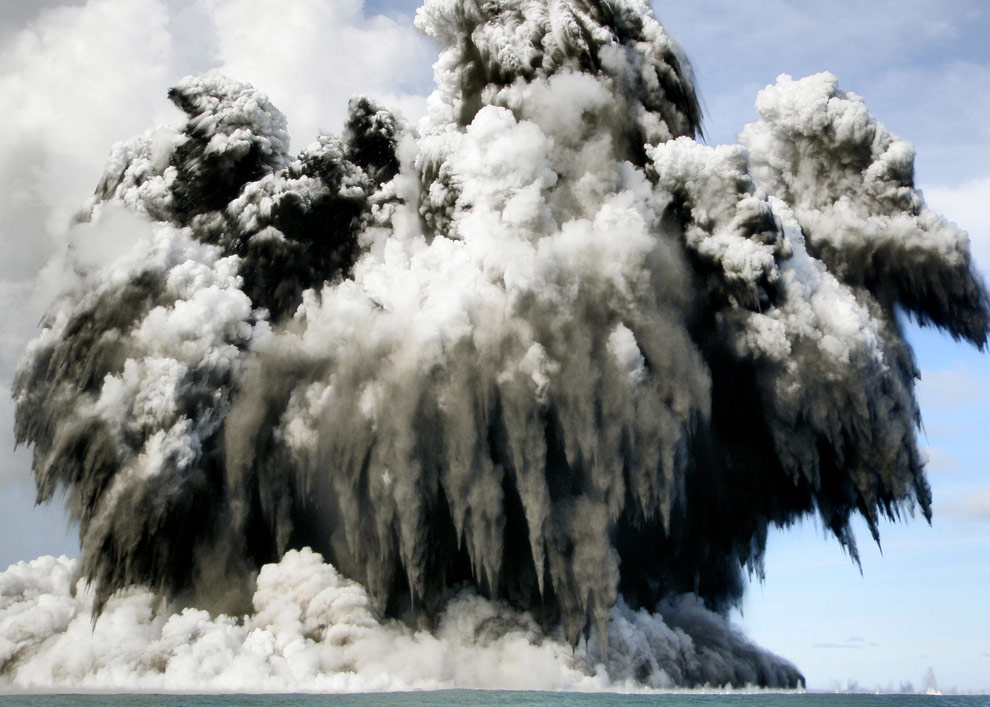
Near Tonga, last week, a volcano exploded with an earth-shattering kaboom from below the sea.
I love the shapes and drama of the black, white, and grey of the ash, steam, and other ejecta.
Boston.com's The Big Picture has some pictures that made my heart pound. I actually made a squeak when I saw #10.
There's no real evidence at this point that the volcano is related to today's quake, and it almost certainly isn't.
.
I love this planet. This is an awesome planet.

I love the shapes and drama of the black, white, and grey of the ash, steam, and other ejecta.
Boston.com's The Big Picture has some pictures that made my heart pound. I actually made a squeak when I saw #10.
There's no real evidence at this point that the volcano is related to today's quake, and it almost certainly isn't.
.
I love this planet. This is an awesome planet.
Wednesday, February 18, 2009
solar eclipse from the moon
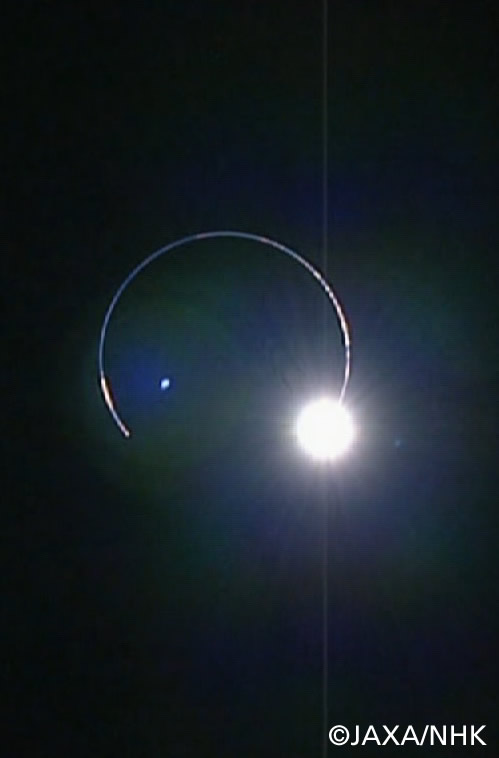
This photo was taken from a craft orbiting the moon, while the earth was between the moon (or at least the orbiting craft) and the sun. http://spacefellowship.com/News/?p=8229. WOW. People on earth would be seeing some degree of lunar eclipse, this says a penumbral eclipse. It's one thing to picture this, but it's gorgeous to see it.
(After I originally posted this, my husband pointed out a simple oversight on my part -- From the moon, this would be a solar eclipse, as the earth is occulting the sun. Were the people orbiting the moon seeing the moon's shadow on the earth, with the sun behind, that would be a terrestrial eclipse.)
http://www.kaguya.jaxa.jp/en/communication/com_information_e.htm#NEW_20090218A
(After I originally posted this, my husband pointed out a simple oversight on my part -- From the moon, this would be a solar eclipse, as the earth is occulting the sun. Were the people orbiting the moon seeing the moon's shadow on the earth, with the sun behind, that would be a terrestrial eclipse.)
Friday, September 05, 2008
I think there may have been an earthquake
When an earthquake happens around here, you run and fill out the "did you feel it?" page -- FOR SCIENCE.
When you do that, among the questions is, "How did you respond?" You can choose between "No answer/don't remember," ""Took no action," "Moved to doorway," "Dropped and covered," "Ran outside," "Other." I mentioned to my partner, "They're missing one." He said, "Run to the computer and look up the quake on the USGS site?" "YES!" So I chose "other," and told them we ran to the computer, and that I thought from how it felt that it wasn't on the Hayward fault (it wasn't, it was on the Calaveras), and that I thought it was a 3.2 or so. Then I saw how deep it was and said, "That's pretty deep, it was probably a 4 or so." And bingo, I nailed it. I used far fewer words to explain this to the USGS.
(If you actually want to read the text in the image, which is a twitter-and-other-things friendfeed screenshot of folks responding to the quake, VIEW BIG.)

When you do that, among the questions is, "How did you respond?" You can choose between "No answer/don't remember," ""Took no action," "Moved to doorway," "Dropped and covered," "Ran outside," "Other." I mentioned to my partner, "They're missing one." He said, "Run to the computer and look up the quake on the USGS site?" "YES!" So I chose "other," and told them we ran to the computer, and that I thought from how it felt that it wasn't on the Hayward fault (it wasn't, it was on the Calaveras), and that I thought it was a 3.2 or so. Then I saw how deep it was and said, "That's pretty deep, it was probably a 4 or so." And bingo, I nailed it. I used far fewer words to explain this to the USGS.
(If you actually want to read the text in the image, which is a twitter-and-other-things friendfeed screenshot of folks responding to the quake, VIEW BIG.)
Sunday, August 05, 2007
quickie - SF after the big quake
Strangemaps shows San Francisco immediately post '06 quake. I love comparing old geography to modern geography, to see how humans have changed things. Look how China Basin once had so much water, and is now mostly filled in.
The epicenter (long thought to be at Olema, at the neck of Point Reyes) was actually a bit left of where the P in "Pacific Ocean" is, on this map, just offshore where the San Andreas goes into the sea near the Daly City/SF line.
Earthquakes simultaneously fascinate and terrify me. I can read just so much about them, and then I have to stop. Seismology is one of my favorite hobby fields, but I don't think I could study it as a focus in geology without becoming a gibbering mass of anxiety.
The epicenter (long thought to be at Olema, at the neck of Point Reyes) was actually a bit left of where the P in "Pacific Ocean" is, on this map, just offshore where the San Andreas goes into the sea near the Daly City/SF line.
Earthquakes simultaneously fascinate and terrify me. I can read just so much about them, and then I have to stop. Seismology is one of my favorite hobby fields, but I don't think I could study it as a focus in geology without becoming a gibbering mass of anxiety.
Subscribe to:
Posts (Atom)