(European Space Agency pic)
I saw it from -32.7ish latitude in South Australia -- quite far north, for an aurora.
It was one of the most magical experiences of my life, and though I'd love to see another aurora, I'll take what I can get.


In 1996, for some reason, the shuttle flew over Sacramento on its way to Edwards.
It went over at the very crack of dawn, so I went outside a bit before that, wrapped in a blanket, and lay back on the sidewalk to wait.
Soon, in the dark east, a hot pink triangle materialized, and slid quickly overhead. I think it was pink from the heat. It was close enough to see that it was clearly a triangle, and clearly the shuttle, but I could see no details.
It moved silently over me, then disappeared into the equally pink sunrise to the east.
I wandered back into my apartment, curled up in bed, then as I was drifting off, the BOOM that you experienced rattled my window glass. I jumped out of my skin, and then burst into laughter.
It was honest joy.
I am a total shuttle-hugger, and that morning made among my most memorable space-related events.

I learned about buying sea creatures in the late ’70s at the sides of two old-time New Haven fishmongers who ran competing markets with differing styles. One brought in every fish he could find, mostly by going (or sending his help) to the Fulton Fish Market, Boston and Point Judith, R.I.
The other relied more on the trucks that worked the East Coast, going from fleet to fleet and market to market: A driver would start in Portland, Me., for example, with lobsters and scallops, and drive to Boston, where he might drop off lobsters and pick up cod and quahogs, then move on to Providence or Point Judith, where he would drop off whatever was in demand and load squid and swordfish. In New Haven he might find flounder. From there, he would hit New York, Cape May, Maryland, right down to Virginia or even Georgia or Florida. Then, his northern load diminished, his southern load — pompano, porgies, spots, snapper — in full supply, he would reverse the trip.
This makes me nostalgic. I may have missed out on the nickel-a-flounder days in New Haven, but I got to shop, learn about and cook fish at a time when my selections were varied and mostly local.
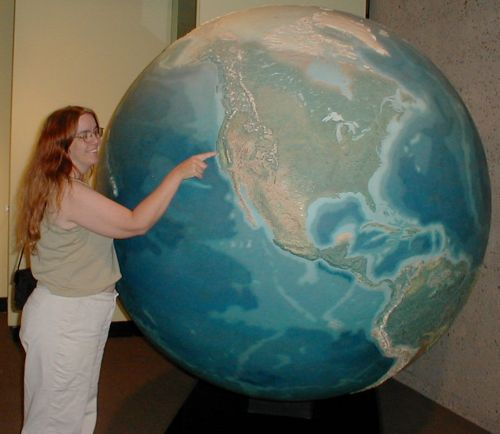
(I read the caption that accompanies this photo after I chose the photo for this post. Oh. See, these things also should be remembered.)
Years ago, in physical geography, we had to color in a physiographic map of the United States. I loved that activity, with colored pencils, and thin pens, and geology references. The teacher told us that we could choose our own colors, and one student showed him her map with the sea colored orange. He said, "I know I told you that you can choose your own colors . . . but just no. No. The sea cannot be orange." And he had her start over. It was sad, but . . . just no.
Hold up the map today that "Governor" Swickard and his compatriots sketched out . . . and the distinctions that made this part of the country feel worthy of statehood in the 1930s — different in its geography, history, economic base and political outlook — are mostly still there.
The undulating landscape of tall grasses that shaped the horsemen and women of the Sioux, Cheyenne and Crow, and the ranchers who came later, is still there, in all its lush exuberance. Economic life shifted gears — coal-bed methane and hobby ranching encroached, sugar beets and flour-milling fell away — but the high grass persists, and that defines the land and the culture — then and now.
"The grass culture — people who make a living from growing grass, or from the animals that eat the grass — that was Absaroka," said Ken Kerns, a 76-year-old rancher who has lived most of his life on the Double Rafter Ranch . . . .


More images from Jefferson: