Showing posts with label rant. Show all posts

Saturday, January 09, 2010

Or maybe they're going to Oregon because it's what Californians do


Curious Sea Lion
Originally uploaded by Dave Schumaker.
I like to write Geographile posts that, if not brief, are either heartfelt and eloquent, or well-researched. Brief ones can be neither. However, this one also is neither. It is ranty and annoyed.

I'm recovering from the flu, and what I want to do, really, is to go play flash games and have a beer, or maybe have another Sudafed (the real stuff) and go to bed.

But instead, there was this earthquake today, which was exciting. And besides all the Jesus Is Coming and similar posts on twitter, the bad science started coming out.

See, last October, the ubiquitous, numerous, smelly, but cute California sea lions at Pier 39 in San Francisco started leaving the area. Then more left, and soon, people were wondering what had become of our sea lions, which aren't historically massed there, but have been as of the past few years.

Within the past couple of weeks, they were found, up with the Steller sea lions and other marine mammals along the Oregon Coast, and at Sea Lion Caves, perhaps due to shifting temperatures, those perhaps due to our currently strengthening El Niño pattern, because that's where their food went. (Yes, there's still a lot of "perhaps," but this was a puzzle until recently, and is coming together.)
.
And of course, because it seemed "suddenly," folks on Twitter are saying, "They knew the quake was coming." (At least one of these twitterers might even be from the bay area or elsewhere in earthquake country, or perhaps sea lion country. Or not.)

But this is not sudden, and there are explanations:

1) The sea lions started leaving in October.
2) Recent, pre-today research suggests that their being found in SW Oregon reflects temperature changes in the ocean off the coasts of California and Oregon, and the food the sea lions prefer is following the temperatures they like. The sea lions are following fish. (Some aren't. Some seem to be hanging out at the Farralons for squid. But many went to the waters off the coast of SW Oregon for fish.)


Now here's the thing:

According to Google maps, from Florence, Oregon, where Sea Lion Caves is, to Ferndale, California, the nearest town to today's quake epicenter, is 285 miles. From San Francisco to Ferndale is 262 miles, by straighter roads. So let's call the quake area halfway in between there. (Yes, I know the sea lions don't drive. But I'm ballparking things here.)

Why would marine mammals leave in October (and later, but still) to swim through where a quake is coming, and end up just as far on the other side ... because they knew a quake was coming?

sealionquake1

It's not like I expect sea lions to have logic, but c'mon: Why? Why not go, oh, to Santa Barbara, the other direction? Why go to all that effort to end up the same distance from the quake anyhow?

And why leave San Francisco when today's quake was barely felt at all there? It wouldn't gain them any advantage.

quakesealion2

Folks are saying, "Animals do strange things." Sure. Sometimes they do. But if you're going to make a wacky connection, at least come up with a good enough story to support it.

Dear people who were kind enough to discuss this with me on twitter today:
I don't mean to be totally dissing you. I am open-minded about, say, that there are aspects of quakes that animals can sense but we don't, and there are noises they can hear that we can't. But look: The idea that sea lions would leave the San Francisco area for Oregon, passing through an area where a quake is going to happen weeks in the future, to end up the same distance on the other side, when there's no good reason for sea lions to care, makes no sense on any level, not even if I were to open my mind so far my brain falls right out.

Tuesday, February 24, 2009

Something called "volcano monitoring"


HDR After
Originally uploaded by linuxjunkiedotcom.
From Governor Bobby Jindal's response to President Obama's speech tonight:
That is why Republicans put forward plans to create jobs by lowering income tax rates for working families...cutting taxes for small businesses ...strengthening incentives for businesses to invest in new equipment and hire new workers...and stabilizing home values by creating a new tax credit for home-buyers. These plans would cost less and create more jobs.

But Democratic leaders in Congress rejected this approach. Instead of trusting us to make wise decisions with our own money, they passed the largest government spending bill in history - with a price tag of more than $1 trillion with interest. While some of the projects in the bill make sense, their legislation is larded with wasteful spending. It includes $300 million to buy new cars for the government, $8 billion for high-speed rail projects, such as a 'magnetic levitation' line from Las Vegas to Disneyland, and $140 million for something called 'volcano monitoring.' Instead of monitoring volcanoes, what Congress should be monitoring is the eruption of spending in Washington, DC.

(emphasis mine)

My guess is that cost him the vote, should he decide to seek the Republican presidential nomination for the 2012 elections, of much of southern Alaska, Washington, Oregon, and Northern California, and perhaps Hawaii too.

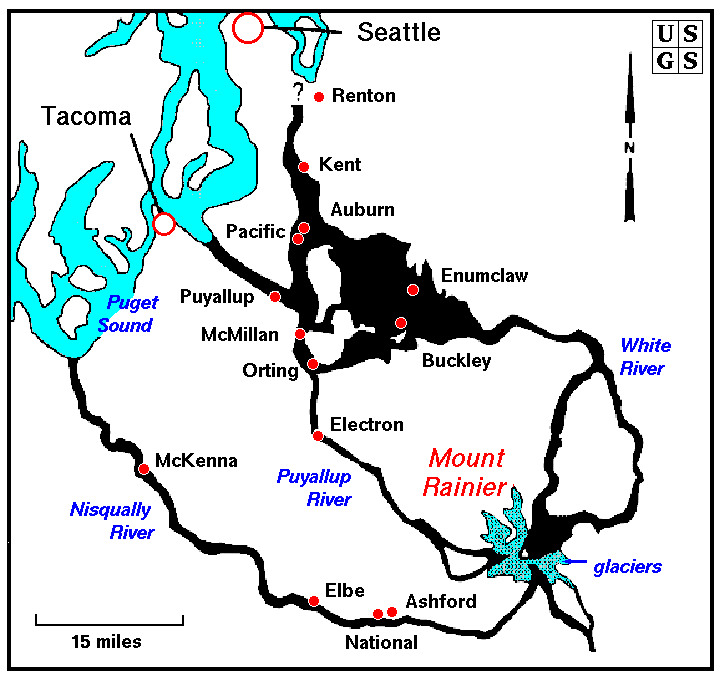
The towns southeast of Tacoma and Seattle, in Washington, are immediately downflow of Mount Ranier, and would receive the brunt of its mud, at the very least. Many towns in that area lie on existing mudflow. Monitoring the Cascades and other American volcanos protects western American cities as much as monitoring Atlantic weather protects southern and eastern cities.

Science really is important, and it worries me when it's brushed off as "something called 'volcano monitoring'," when it's treated like an elitist hobby. Americans can do it -- but not without good hard science.


(edited to add: Geologist Maria Brumm added the fiscal element: "I wish I'd thought of that.")

Friday, February 20, 2009

Springtime for Greenland

Scientists measure fresh water loss down a moulin on the Greenland ice cap:


First thoughts:
1. Do we have data on melt from a decade ago? from the early 70s? How much has it changed? There had to be some surface melt back then, or the winter snow would be thickening the ice cap every year. I'm sure they know how and why it's worse and scarier now.
2. I'm not fond of heights to begin with, and of abysses in general. I couldn't have hung from those ropes.
3. I was a bit annoyed by Dr. Box saying, "It's just bottomless. No light escapes." Was there some sort of light source at the bottom of the hole that light should be escaping from? But I sort of get what he means, his choice of words just didn't work for me. It's so deep and narrow that it goes black immediately, and once you're down there, you're down in a deep black pit, ice water all around you, battered by ice on all sides, and you're going to die.

I'm one of those people who believe our climate is changing, and that most, but not all of that change, is human-caused. Humans can adapt, but I think we'll lose a lot of biodiversity, like emperor penguins, polar bears (do I really need to link those stories?), and any plants and animals that already live at extremes of height or heat, whose habitats will change beyond their ability to adapt. In addition, animals that could move to adapt will be blocked by human change -- long, narrow reservoirs in Canada, cities and highways and farmland elsewhere in the world.

We can't stop it. We can slow it if everyone works together, but everyone isn't -- and not everyone can. But I think the winds are changing, and we'll get there. There will be certain losses, and certain sacrifices, but we're finally hitting the brakes a bit, and we'll get there.

I'm a little glad for Greenland in the short term. They had some decades of being green a millennium ago, with dairies and farms. I hope they can make use of climate change to help themselves, for the time being.

Wednesday, September 26, 2007

Three Gorges Dam pisses me off


Three Gorges Dam @ Sandouping
Originally uploaded by e_hoogie.
I used some pretty colorful language when I first heard about this:

In unusually frank language, Chinese officials publicly acknowledged "hidden dangers" at the massive Three Gorges Dam, including landslides, erosion and pollution that could lead to an environmental disaster if not quickly fixed.
"If no preventive measures are taken, the project could lead to catastrophe," the official Xinhua news agency said on its English-language newswire, paraphrasing experts speaking at a conference this week. As an indication of the government's sensitivity to the issue, that phrase wasn't included in all versions published by Xinhua.


and

It was hailed as one of the engineering feats of the 20th century. Now the Three Gorges Dam across China’s mighty Yangtze River threatens to become an environmental catastrophe.


and

"We cannot lower our guard against ecological and environmental problems caused by the Three Gorges project," Wang Xiaofeng, director in charge of building the dam, was quoted as saying. "We cannot win by achieving economic prosperity atthe cost of the environment."


Geological instability isn't the only unforeseen negative effect of the Three Gorges. Downstream of the dam, locals have been battling two billion rats forced into farmland by rising water levels after the dam authority released a large amount of Yangtze River water "to control flooding in the face of the annual rainy season".

Two billion rats.

People have been crying about this for years. A friend of mine in the early nineties, while in her mid-sixties, took a boat tour down the gorge because she thought she'd never have another chance to see it if she didn't go now. People have said we'd lose the river dolphin, for years. People have warned against pollutant build-up in the water, where folks get water for cooking, and bathe their babies. They worried about whether silt would fill the basin too fast, given how muddy the Yangtze is, or that the silt and other materials carried downstream would damage the turbines. They rallied against corrupt officials mishandling the funds used to relocate people, and of people whose rich farmland on which their families had worked for hundreds of years would be flooded, while they were given rocky hillsides as compensation. They raised a fuss about the drowning of barely visited or newly discovered archeological sites, of the loss of historic temples, of the effect on the people below if something happened to breach the dam. But there wasn't anything anyone could do to stop this dam.

Now that the damage has largely been done, they admit that there could be problems.

I just want to kick somebody.