Saturday, December 19, 2009

The Universe, and the Tibetan Plateau


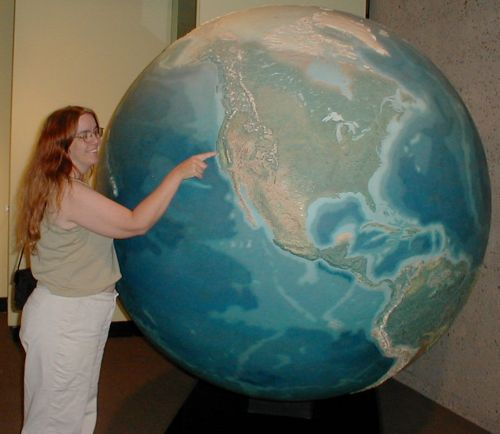
P1010283
Originally uploaded by yingzhao.
This new video from the American Museum of Natural History is making the rounds. It's a stunning digital visualization of the known universe with proper sizes, distances, scales. I'm not sure exactly how they increase speed of change. It definitely changes, as it takes a few seconds to travel a few light seconds, then not long after, a few seconds to travel many light years, or a few million light years. It had to be thus, but I did lose a sense of scale eventually, even with the incredible illustrations.

I had no idea, for instance, how much completely unmapped space there is. Why is that? I can see it being hard to map past the center of the Milky Way, but couldn't tell in which directions we're yet unmapped, and why -- could be be that hard to map in the opposite direction from the center? Are the stars densely packed that direction, for far enough to make it opaque for us?


Of the whole video, though, my favorite part was tipping past the Himalaya to see the lakes of the Tibetan Plateau. I had no idea how lake-rich the area is. I knew that it was sparsely populated, that big quakes there can go almost unreported except by instruments, that there are thousands of square miles with no roads. But the lakes just caught my attention: Look at all this gorgeous water. What's it like there? Who lives there? What do they do?

It turns out google and flickr both had answers for me.

Wednesday, December 16, 2009

lunacy, really

According to Phil Plait, at least 90% of all murders happen within a week of either the new moon (like right this minute) or the full moon.

Amazing, really, when you think about it.

Photo by JPStanley

via Creative Commons search

on Flickr.

Saturday, December 12, 2009

Mountain of Ghosts - Algeria - November 2005


"There's enough sand in the Sahara to cover most of North Africa." - Martin DeMello, December 2009

It's really amazing what you learn on the internet, these days.

Thursday, December 10, 2009

Geologists rock!

Might be that a certain road crew should take geologist Vanessa Bateman out for coffee.

The video gets interesting at about 1:00ish.


I'm really not sure I wouldn't have flipped the hell out, watching this. Then I'd have asked Bateman to follow me around and be my body guard.

(via agweb, thanks to Silver Fox for the story, thanks to @caroldn for the new title)

Tuesday, December 01, 2009

Excerpts of the President's Address to the Nation, Dec. 1, 2009 in a tag cloud

So ... if we were to pull out *this week,* what would happen in Afghanistan over the coming year?

Tuesday, November 24, 2009

The Anthropology Song

Anthropology is close enough to cultural geography to count, for me. I like this song enough that I played it in the background while I did other things a few times today.

Saturday, November 21, 2009

What if Earth had rings like Saturn?


I don't want to interrupt the loveliness of this idea, but there are bits from the video and the comments that I want to note:

Someone commented that this might make places under the rings where it was permanently dark. But because the earth is tilted on its axis and the sun appears to move north and south through the sky seasonally, so would the shadow move. But it's likely some places (the equator, generally everywhere between the tropics) would get some level of shade from the rings. The layer is very thin; aside from under the rings at equinox, there would be plenty of bright sun. Would there be enough insolation change to affect climate? Probably. But given the scenario, I expect the earth would have evolved this way, it's not like it would be a change from how things are now.

The person who made the animation seems to have designed it for equinox. Seasonal variations aren't addressed at all.

The theoreticals (e.g. one commenter's note that this would affect satellites) are irrelevant to me: It's beautiful.

Saturday, November 14, 2009

Accra - A C C R A

I don't know the capital of every country in the world, nor do I think I *should* - but this is still fun:


When I was little, and couldn't sleep, Mom suggested I list every single state in the US, alphabetically. If I ever realized I'd missed one, I had to go back and start from the beginning. I don't think I made it to Wyoming.

I found myself, as I passed San Bruno Mountain today, where the endangered Mission Blue butterfly lives, "There are Mission Blues on San Bruno Mountain, but the California dogface butterfly is our state butterfly. Why do I know that? I don't know. I just do."

It's the sort of useless thing that helps me paint a picture of the world when people talk about it. It's a piece of the whole puzzle.

Thursday, November 12, 2009

Africa from Europe on Google Streetview

From Google Sightseeing


How cool is that? That is very cool.

We're fostering a tiny puppy, switching the garden over into fall mode, trying to get our house in order, and I'm finishing a semester at school. This is Geography Awareness Week, and I think there will be a post about that before the week is up.

Tuesday, October 20, 2009

sense of place - Oakland Hills Fire


Oakland Hills Fire -- after
Originally uploaded by marymactavish.
For some reason, as I go through my old photos, the fire photos are really affecting me. Even before I noticed them in my stack of "photos to scan," I was noticing again how the hills have grown up thicker with eucalyptus than before, and the plan to places houses farther apart and make roads wider is barely there. And I might be wrong, but I think that Oakland never did get around to making its fire hydrants compatible with the hoses of surrounding towns' fire departments.

But anyway: I'm thinking of it, eighteen years later.

Saturday, October 17, 2009

sense of place - Loma Prieta quake, twenty years ago


Downtown Berkeley
Originally uploaded by Susan Decker.
Visual memory? How about visceral memory!?! This gave me a chill.

I was standing exactly where the guy with the shorts is standing at 5:04 pm on October 17, 1989.

Friday, October 16, 2009

Look! Up in the sky! It's a bird! It's a plane!

It's the moon! It's meteors!


Pretty much everyone knows that I have a broad definition of "geography," right? Usually, if I can see it from earth, or if what happens there is directly relevant to earth, I'll often decide it counts. For awhile, I pondered having a day a week set aside for related sciences, but I've mostly given that up. If I post them here, I'll find a way to make them geography-relevant.

But this trailer is about an event that involves people on the ground looking at things relatively close to us, including within our atmosphere, so I think it's all about geography. Check it out. It's a lot of fun.

Another student presentation - uses of the rainforest

Wednesday, October 14, 2009

"oh AWESOME"

I've never been tidepooling at night. This makes me think I should definitely try it.


I love hearing grownups, especially teachers, say "OH AWESOME."

Tuesday, October 13, 2009

Why did Georgia flood so badly this year?

This guy talks about a couple of reasons quite clearly, if a little over-excitedly. He makes good points. There are probably hmore reasons, but these are the jist.


(About his first argument: Fall flooding like this was pretty much predicted by models.)

Monday, October 12, 2009

Feed the child


Me and Paula, 1975
Originally uploaded by marymactavish.
I grew up in a 1950s housing development, thick with oaks and chaparral, on the edge of fields and oak woodlands, near the banks of Churn Creek. Mom let us dig in the yard – I loved my real metal Tonka trucks and old silverware digging tools – and we camped in rural Shasta County several times a year. In the hottest months, when the house was too hot to sleep in at night, we slept on the back lawn, and watched meteors fly overhead, while Mom taught us the names of constellations.

I learned to swim in creeks and lakes. I peeled endless acorns in my attempts to make acorn mush under trees while friends had tea parties in their bedrooms. I used my magnifying glass to set small piles of oak leaves on fire in my driveway, knowing better than to try that out in the woods.

When I was little, we were allowed to run around the woods (some of it has become a giant church complex, some is now protected as park) and nearby fields. I think I was 7 or 8, just old enough for my mother to append “bring your sister” to my requests to go play “in the fields,” as we called them. My sister wasn’t yet in kindergarten, and hauling her along was like dragging an anvil behind me as I ran off to the trails and creekside on the road to adventure.

Mom taught us how to avoid rattlesnakes and poison oak (we didn’t assume there were mountain lions around, but there had to be, we were right on the edge of town), and told us to be home before dusk, then sent us out to play. There was really nothing we were forbidden except to go into the rain culvert where Churn Creek went under Highway 44, in case of flash flood – so we did, of course, and would stand under the stormwater grates and listen to the roar of cars and trucks overhead, reveling in the danger. I didn’t climb trees, but the live oaks and black oaks often had multiple lanes of commuting black ants, and the gray pines were sticky with sap, and weren’t good climbing trees.

Instead, we collected sticks and branches and crunchy, prickly fallen leaves and wove forts not much bigger than our bodies. After intense summer thunderstorms, we’d go out to where the boys on their bikes had worn ruts over the dead grass and hard dirt near the creek, and slide down the mud-slick ramps on our bottoms. We had church clothing, school clothing, play clothing, and “mud clothing,” the bottom of the barrel, as Shasta County’s iron-rich soils leave permanent red tint on any clothing that touches it when it’s wet.

We picked wildflowers in the spring, and on the first of May, we made paper baskets, then filled them with brodaeia and shooting stars and lupine and wilting poppies and hung them on neighbors’ doorknobs, ringing the bell, then running away. We knew the names of most of the flowers – Mom called everything by name -- but she called all the brodaeia species “blue dick,” and called all the hummingbirds “ruby-throated” because in our basic birding guide, that was the only hummingbird with a red throat. (Anna’s weren’t in the book, and weren’t part of Mom’s Modoc County childhood, as they’ve only gradually moved north with human population.) Turkey vultures were “buzzards.” Everything had a name, though they weren’t always accurate names. We called gray pines “digger pines,” as that was their name then. We knew they were named after the foothill native people who were called “Digger Indians,” but even though my grandmother was an advocate for and sympathetic friend of the Pit River and Maidu people, it never occurred to any of us that “digger” was a racist euphemism.

One of my iconic memories that defines what gave root to my adult curiosity came on a late spring day, on one of the several trips to Burney Falls and Mount Lassen that we took every year. Redding was much smaller, then, and roads in the surrounding hills were often quiet. We were somewhere up near Kings Creek or Hat Creek, and there were turkey vultures rising on the morning thermals. They seemed to be doing their morning cruise more than looking for food, so Mom pulled over. “Get out of the car,” she told one of my older sisters. “Lie down in the middle of the road.”

Terry’s mouth fell open, and she shrieked, “WHAT?”

“Just lie down.”

“I’ll get run over!”

“I’m watching, I’ll tell you whether a car is coming.”

These days, ornithologists know that turkey vultures hunt by smell, not sight, but in the sixties, most people hadn’t learned that. My sister lay in the middle of the road for awhile – a minute, or five minutes, I was young – then leaped up to brush her clothes off and yell at Mom for risking her vulnerable child’s life.

The vulture hadn’t landed, no traffic had come by.

Had a vulture landed, would Mom have allowed it to pick out Terry’s eyes? Would she have scared it off? I might never know. Mom was that kind of woman.

This is the story that I most vividly remember, about Mom’s fascination with nature, and how she fed it to her children, but it’s one of many. Her willingness to live in nature, not as a spectator, but as an active participant, flowed onto and into me along with her milk and her singing when she was happy, and later her taste for ginger and marzipan.

Wednesday, October 07, 2009

In Science We Trust?

Put on the headphones if you're at work. It's worksafe, but there's music. The first few seconds of the video explain the point of it all:

Tuesday, October 06, 2009

They really don't make flags like they used to

Wikipedia says: "The Benin Empire or Edo Empire (1440-1897) was a pre-colonial African state of modern Nigeria. It is not to be confused with the modern-day country called Benin." In Nigeria, Benin City still sits to mark the region, a central part of the slave-trading region of the 17th century.


I want to learn more of the kinds of world history I missed in middle and high school, either because it just wasn't taught (where do kids learn about the Benin Empire in high school history?) or because in all my moving around (five high schools, really and truly) in my youth, I missed out on some curriculum.

This is the sort of thing I've missed.

(Thanks to Boing Boing for the pointer

Saturday, October 03, 2009

Nothing's where you think it is


"What do maps have to do with social equality, you ask?"

The good doctor (don't let me say "phlox" here) has a point. Size on a map matters, kids grow up seeing disproportionate sizes, and perhaps, attributing disproportionate values, even unconsciously. I think that as they learn mapping, learning about different projections, and the reasons for them, will continue to be important.

When I lived in Australia, I had a "corrective map of the world."

How much do these things matter? Why?

And I did crack up at the video clip. A lot.

Thursday, October 01, 2009