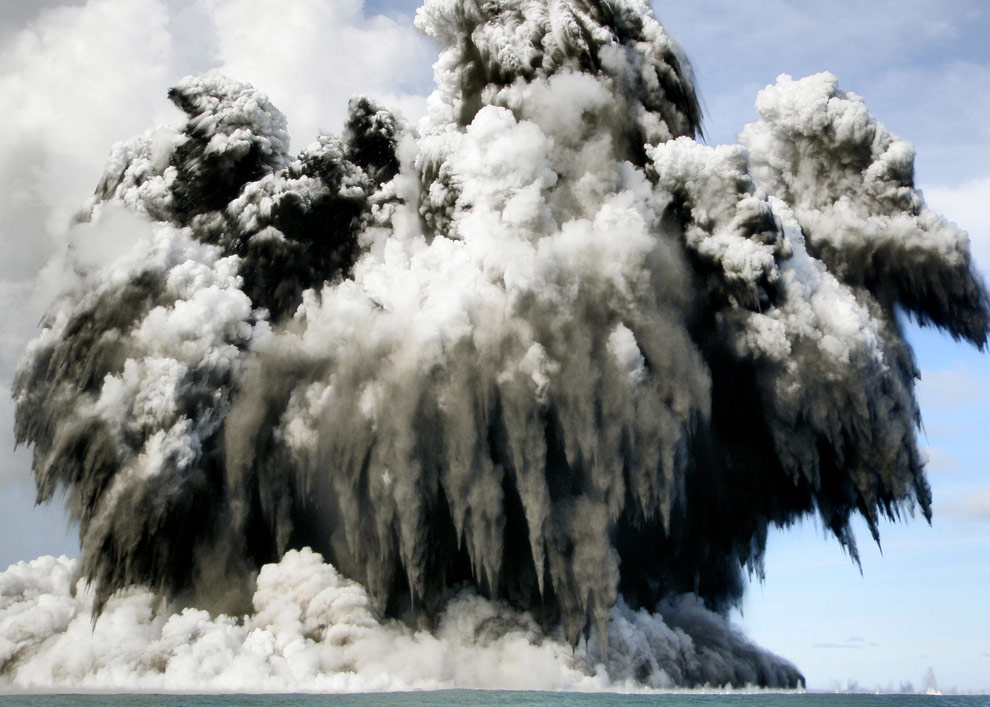
Yann Arthus-Bertrand takes some of the most beautiful aerial photos I've ever seen, most of them from the Ultralight aircraft he sails over the earth with.
Designer (creative director) Rhett Dashwood poked around on google maps for Victoria, Australia, and came up with an entire alphabet. I thumbnailed it for blogging, but am leaving you to go see the big version on his own website.
I need to take a little time and do one of these on my own. What fun.
Wildobs lets you upload the location of wildlife you find around North America (at least) with details about habitat, and mapped locations. I am going to explore the area near where I live, find out what's around at this time of year that I haven't yet noticed, and go look. It's a perfect "get outdoors now!" computer toy. (There's an associated iphone app, too. I don't see anything for my Treo yet.)
The San Francisco bay area usually has relatively moderate weather, with the occasional scorcher in July or August. This is the first time I can remember three days in a row like this in April.
The thing is, only houses built since the mid-70s routinely have insulation, and far fewer than that have air-conditioning. Our house has no insulation at all, and despite having a patio on the south side and small windows on the west side, we can spend much of a warm day 5ive to ten degrees hotter indoors than outdoors. We start the day, on days like this, with fans at about 6 am. When the air blowing in goes from neutral to warm, we shut off fans, close windows, close up the master bedroom with the tiny in-room a/c unit, and hang out together in the one room. On a 95 degree day, that bedroom can be kept at about 80, while the hallway will be 86 or so, and the rest of the house at 90-100.
The blessing is that it's not humid. One of my most miserable days was in June 2006, in Boston, when it was 100F outside, 90% humidity. And just as a warning: There's nothing worse than smelling the tar decks of the USS Constitution on a day like that, then going to a kosher deli/restaurant and watching a waiter carry a pile of wiggly gravy-covered meat loaf past your table.
But I digress.
Here, it's about 93F right now, but humidity is in the mid-20s. It's starting to feel cooler outside than inside so I've reopened the house and turned the fans back on. I'm lying around, typing and sweating, with an ice pack between me and the laptop. It's not so bad.
We look moderate on paper partially because though we have days like today, the forecast for Friday is in the high 50s with a chance of rain, and just this time last week, I took this little video 20 miles from here, on a chilly afternoon.
(Photo was taken in San Francisco yesterday. It's possible the sensor was in the sun.)
On April 14, Michael Byrne, the new GIO for the State of California, explained the duties of the GIO office, and his position.
It seems like the right move, now, with so much of what happens in California facilitated by mapping and aerial photography, to integrate agencies and services with shared GIS directions and resources.
Sometimes, simply repeating a conversation sums everything up.
I love google. I love knowing where to find information. And I can't not know some things. This then comes back to my obsession
I had this instant-message conversation, just this morning:
(11:09:33 AM) Me: Casey asked me if the strait of gilbraltar were closing or opening -- I didn't know for sure. (11:09:42 AM) Kimberly: : heh, no clue (11:10:01 AM) Me: So now: Would you like to know about the geology of northern africa and the african/eurasian plate boundary? I had to find out. (11:11:02 AM) Kimberly: : of course I would like to know! (11:20:10 AM) Me: *grin* The African plate is moving north pretty fast, but most of the compression is happening in (causing, in fact) the Atlas Mountains, not closing the straits. (11:20:49 AM) Me: The straits gradually opened from about 25 million years ago to 5 myo, but have been slowly, slowly closing since, with most of the compression happening elsewhere in the mediterranean, local N. African mountains, and 45% of it in the Atlas Mountains. (11:21:43 AM) Me: I said to Casey, "You knew I couldn't not know, once I realized I didn't know." Casey said, "I know. It means I don't have to do my own research." (11:21:52 AM) Kimberly: : lol
I'm sure some of the information is vague and/or inaccurate, and I certainly provide no citations. It was based on 15 minutes of reading from links I found via google. But still: This is how my life often goes.
I used to know someone who kept a stack of books -- KJV (which he'd read through, and studied), probably the Jerusalem Bible, books on Paganism, the Book of Mormon, Buddhist texts, all sorts of things -- in a stack on the table next to the front door. He was an obsessive reader of psychology and theology, and every time something caught his eye at a book sale, he'd bring it home, and devour it. When folks wanted to come in and talk religion, he could do that, and did, and would sit them down for an hour or more to discuss things they weren't always ready to discuss. He'd pick up his books and leaf through until he found a relevant passage, read it, and bring it into the conversation. The proselytizers never managed to convert him from basic agnosticism, but it passed the time for him, and he liked meeting new people.
If this Geohovah's Witness guy showed up at my door, I'd take him to my special geography table and show him my atlases, geography texts, books about water policy and fire control in chaparral and bird identification and food politics in developing nations and plate tectonics and biodiversity, and of course, offer him coffee and cookies and we'd chat.
I must sound like him sometimes. I can't drive down Mission Bl. through Hayward, in California, without pointing out the Hayward Fault scarp. I can't be along the marine terraces of Highway 1 without explaining how they were formed. I especially can't see serpentine soil (or serpentinite) without getting into a discussion about its formation and ecology.
Water towers in Alameda County -- the kinds that used to sit in back yards, and hold water pumped up from the ground with windmills, for the households -- fascinate me endlessly. Can I control my urge to tell people about them, if they don't already know? No, not really.
I am a geography evangelist. I think I must annoy my friends sometimes. They say they don't mind, but I wonder.
(This sounds like I don't get the point of the video. I do, it just got me musing.)
This isn't meant to be a Zappos ad, I like the company but don't have any vested interest in them at all, and am not any sort of shoe-diva. I am just in love with that map, the concept, the execution, the sheer for-the-sake-of-it goodness.
Years ago, in physical geography, we had to color in a physiographic map of the United States. I loved that activity, with colored pencils, and thin pens, and geology references. The teacher told us that we could choose our own colors, and one student showed him her map with the sea colored orange. He said, "I know I told you that you can choose your own colors . . . but just no. No. The sea cannot be orange." And he had her start over. It was sad, but . . . just no.
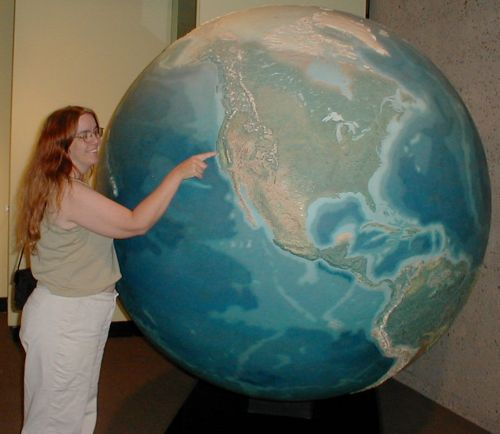
And yet a bit more fluff .... but this is me. And this is me doing what I always do when I encounter a big map. I have to touch it (if I can) and find recognizable features, and talk about it, and triangulate.
This is a big, flat map without most labels, and I had to wander around it and talk about it, and tell my companion about the White Mountains and the Bristlecone Pines, and (here) the various drainages of the Feather River, and about the Sutter Buttes and how they're a tiny mountain range, and we had to find the original Brokeoff Mountain remnants around Mount Lassen, and I could have stayed and looked at it for another thirty minutes or so.
I want this for my house. Is that too much to ask?
It's near the climate change exhibit at the California Academy of Sciences in Golden Gate Park. Go check it out. Say hi for me.
As glaciers on the west coast of North America melt, we will lose countless millions, or even billions of representatives of a creature that lives only in those west coast glaciers.
Mind you, these are just the ice worm. We'll also lose alpine plants and animals that have migrated to as high and cool as they can go or as dry as they can go, water storage in snowpack and glaciers, riverflow, and some existing air circulation patterns. More will be revealed. We shall see, we shall see.
Holy cow this is amazing lightning video! The annotations label the various leaders.
I grew up in a part of California that has summer lightning storms, but even those amazing storms weren't like storms can be in other parts of the US and the world. Lightning still enthralls me, rather than scaring me.
I sat through one storm in Arizona, once, under shelter, watching the occasional distant glow of a transformer exploding under a strike. That was enough of the big stuff.
I collect natural history, environmental, and geography books, almost compulsively. I look for used versions where I can (to save paper) but also appreciate that many of these books come out in runs of a few thousand copies, and aren't profit-makers for the publishing companies, so when they come out new, I buy them while they're new. If you like Geographile and want to let me know, please either comment on my posts, or visit my Powell's wishlist to feed my book collection. You might find books you like there, too.
I am a middle-aged geographilic student and writer. You can find me on Twitter as @geographile (mostly geographilic feed/retweets/info) and @mactavish (more personal, still science-oriented).