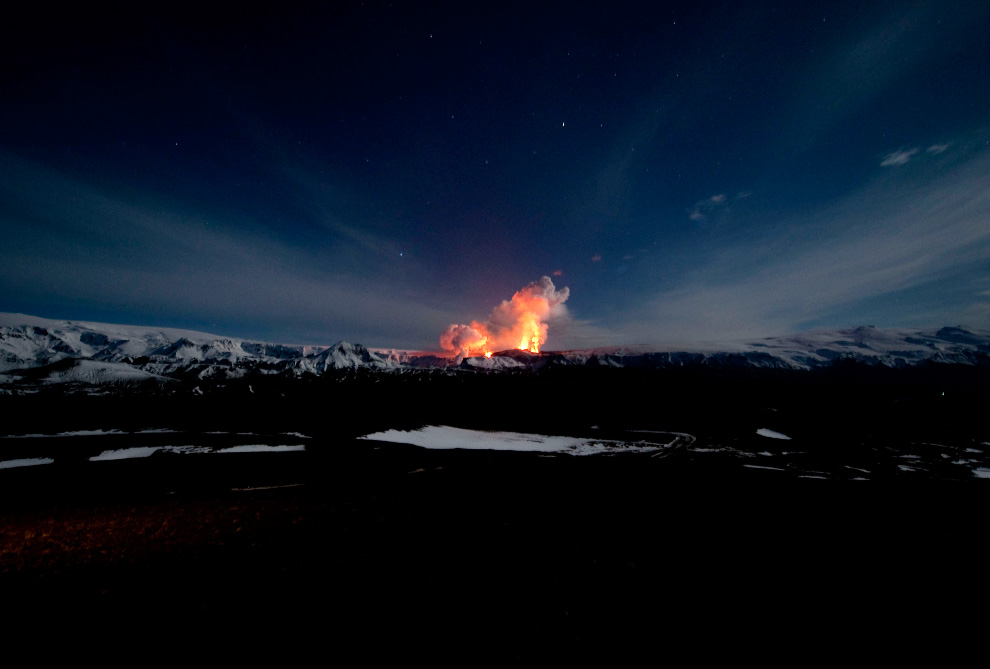
Brian Romans, from Clastic Detritus, pointed out on twitter that in recent Icelandic volcano footage, one can see amazing shock waves propagating through the ash cloud after explosions.
Wow! The air vibrates beautifully. Have a look. It happens several times in this video.
The name Eyjafjallajökull is made up of the words eyja (genitive plural of ey, meaning eyot or island), fjalla (genitive plural of fjall, whose nominative plural is fjöll, meaning fells or mountains) and jökull (meaning glacier, cognate with the -icle in icicle). A literal translation would thus be the "island-fells glacier" or the "island-mountains glacier". The name Eyjafjöll describes the southern side of the volcanic massif together with the small mountains which form the foot of the volcano. The village and museum of Skógar are also part of the region undir Eyjafjöllum (meaning "under the Eyjafjalls").
So it's Eyjafjöll that's erupting? It's complicated.
I had the opportunity and pleasure today to listen to a live-streamed lecture from Professor Brian Cox, at Manchester University, about the LHC, exploring space, and curiosity-driven science.
He talked about the LHC, and the math involved in research of subatomic particles, quarks, Higgs, a little about electromagnetism. He pointed out Earth in one of my favorite solar system photographs.
He reminded his listeners that it's important to know why we're doing what we're doing, and that for him, like for Sagan, one must start with the beauty and wonder, then get into the details as part of that. Richard Feynman was another scientist who held that mastery, who was delighted at the world, the universe, and for whom science was an expression of that delight.
Prof. Cox wound down his lecture with this, from Carl Sagan, who was responding to a photograph taken from Voyager, as it looked back on the solar system it had just traveled through:
From this distant vantage point, the Earth might not seem of particular interest. But for us, it's different. Consider again that dot. That's here, that's home, that's us. On it everyone you love, everyone you know, everyone you ever heard of, every human being who ever was, lived out their lives. The aggregate of our joy and suffering, thousands of confident religions, ideologies, and economic doctrines, every hunter and forager, every hero and coward, every creator and destroyer of civilization, every king and peasant, every young couple in love, every mother and father, hopeful child, inventor and explorer, every teacher of morals, every corrupt politician, every "superstar," every "supreme leader," every saint and sinner in the history of our species lived there – on a mote of dust suspended in a sunbeam.
The Earth is a very small stage in a vast cosmic arena. Think of the rivers of blood spilled by all those generals and emperors so that, in glory and triumph, they could become the momentary masters of a fraction of a dot. Think of the endless cruelties visited by the inhabitants of one corner of this pixel on the scarcely distinguishable inhabitants of some other corner, how frequent their misunderstandings, how eager they are to kill one another, how fervent their hatreds.
Our posturings, our imagined self-importance, the delusion that we have some privileged position in the Universe, are challenged by this point of pale light. Our planet is a lonely speck in the great enveloping cosmic dark. In our obscurity, in all this vastness, there is no hint that help will come from elsewhere to save us from ourselves.
The Earth is the only world known so far to harbor life. There is nowhere else, at least in the near future, to which our species could migrate. Visit, yes. Settle, not yet. Like it or not, for the moment the Earth is where we make our stand.
It has been said that astronomy is a humbling and character-building experience. There is perhaps no better demonstration of the folly of human conceits than this distant image of our tiny world. To me, it underscores our responsibility to deal more kindly with one another, and to preserve and cherish the pale blue dot, the only home we've ever known.
I was going to put together an Earth Day post today, and I might still -- it's a busy day, I wasn't prepared ahead of time.
But I think that Sagan had it all, right there. The rest is just detail, it's about how to do it. That's what I'll get into later.
Dan Satterfield linked on his facebook page this news video of the meteor that lit up the midwest last night:
The Christian Science Monitor (which has a great photo of the fireball) says
A large flash of light at about 10 p.m. Wednesday night – described as a fireball in the sky by eyewitnesses from Wisconsin to Missouri – was most likely a meteor from the ongoing Gamma Virginids meteor shower. It is unknown whether the meteor in Wisconsin, which was seen flying eastward at an altitude of 6,000 to 12,000 feet, hit the ground or burned up in the atmosphere.
From AlJazeera, an information-filled and relatively accurate story (text story at that link) about the effects of Eyjafjallajokull's eruption:
The BBC has more too, on their site, including this important tidbit: "The UK's air traffic control service (Nats) said no flights would be allowed in UK airspace until at least 0700 BST on Friday amid fears of engine damage."
My initial reaction was actually (in text, to a friend), "omg omg omg omfg geology."
Right now, several airports in Europe (specifically Norway and the UK) are closed because of ash.
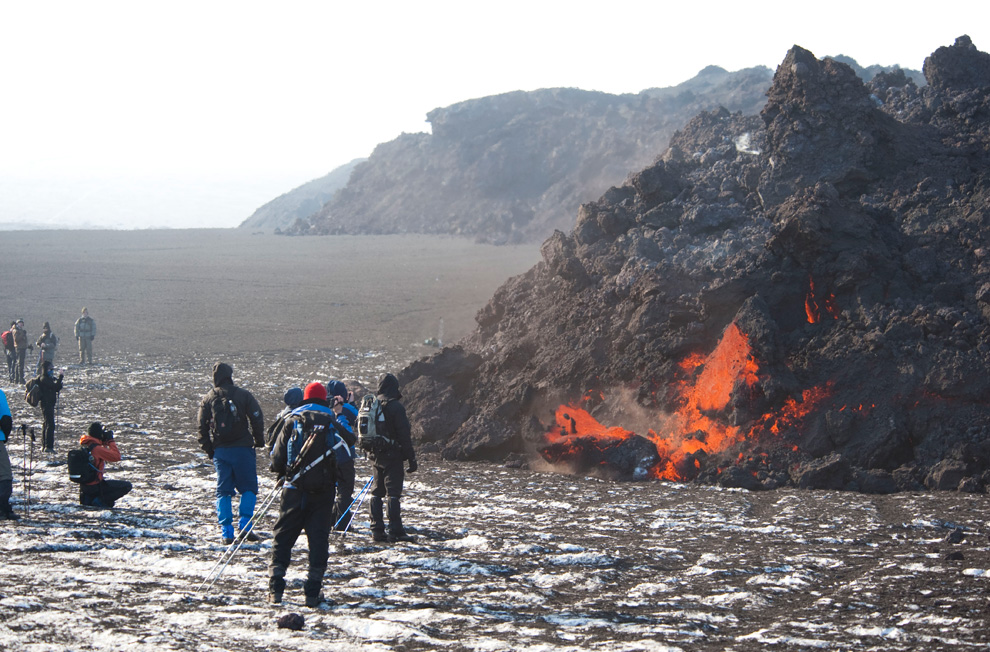
Boston.com's "The Big Picture," one of the best photoblogs on the web, collected pictures of the volcano and its effects today. Some aren't the usual fare, some are especially dramatic, but I think one that most caught my eye was #11 - people in snow gear, standing on dirty snow with ski poles stuck in it, watching flowing lava from a few feet away.
(And for the sake of fun: KCBS said, on twitter: "Why we're just calling it 'a volcano in Iceland'. Try saying this: Mt. Eyjafjallajökull (ay-yah-FYAH'-plah-yer-kuh-duhl)" Wikipedia provides the IPA [ˈɛɪjaˌfjatlaˌjœkʏtl̥]) and an audio clip to unconfuse things.)
Addendum: My friend Ailbhe, in the thick of things, clarifies the current airport closure and flight diversion issues -- "UK, Ireland, Norway, Sweden, Denmark, north Finland, Belgium, north France, the Netherlands in parts" -- and provides a link to a good reason: Volcanic ash destroys airplane engines catastrophically.
I did spot one major technical/factual mistake, though.
(Have I posted this before, years ago? I should look. But it's a cold, rainy morning, and the dog is asleep on me, and that sounds like a lot of work for today.)
She said scientists would not have enough information to identify the fault until geologists survey the area.
The quake occurred at the junction between two tectonic plates, the Pacific and the North American, that grind against each other through Baja California and California. The quake is probably on a strike-slip fault, which splices through the ground vertically and causes land to move horizontally.
A house collapses in on itself in Mexicali.
A telephone pole pulls wires down in Mexicali
Cars drive over a slightly buckled road in Mexicali
Commercial buildings crumble slightly in Mexicali
A picnic area shifts dramatically
In Ensenada, a twitterer's laptop sits open in front of gaping wall cracks. (Note Tweetdeck open, perhaps following the news.)
And in El Centro, California, a family's deck lies in their back yard. I thought we had better construction standards than that!
More news is coming in, of course, the "did you feel it?" map is still changing. The quake was only 10 km deep, and I have no doubt we'll hear about more damage than is known so far. As quakes usually are, this one will be another learning experience.
The general public really needs a good bridge between sometimes complicated science and what we are able to assemble into a useful picture. Clear, simple, fact-rich science communication is essential, good science communicators are priceless anymore.
That's why Dan Satterfield is one of my favorite science communicators. He's direct, smart, and really gets to the point, understanding what his readers need filled in. His most recent blog post really makes that clear to me. Dan goes step by step through not only the reasons why climate change is now scientific reality (with some amazement at the TV weather people who dismiss it as myth), but he also insists its the TV meteorologist's obligation to sort it out for the watchers, for the folks at home whose only exposure to real scientists and balanced science throughout the day might be what they get from their trusty TV weatherguy.
Dan's also just plain good folks. But he's good folks with a sharp mind, and the kind of understanding of his audience (both for his blog, and on TV in Alabama) that teaches rather than preaches, that informs rather than lambasts, that gets the point across in the way we need right now.
He's the kind of science communicator that we can point at as part of the solution to the problem. When you hear people saying, "If only we could communicate science to the masses," point them to Dan's blog, and say, "You mean, like that?"
Steven Bumgardner, who produces Yosemite Nature Notes for the National Park Service, shot some video of "frazil ice" on the Merced River in the park this week, as a cold early spring storm moved across California.
The History Channel's new series, "How the Earth was Made," is mostly just scientific enough for me today, as I'm fighting a low fever, and wanted to stare at something educational without spraining too many neurons. Today I sat down with Hulu and watched an episode about the creation of the Great Lakes.
I knew some of it, such as the glacial history, but hadn't known about the igneous origins of the floor beneath Superior and Ontario. The series is presented in steps, giving evidence for theories (with a bit of the History Channel's typical "but that's not all" and "there's more they didn't know," and "but still, mystery remained" drama), then before each ad, recapping the bits. I appreciated those, it helped me knit the story in stages before going on to the next chapter in the story.
As it turns out, I had no idea how fast Niagara Falls was receding. Do you know? What would you guess? Watch the show and see. I was a tad stunned.
My friend Andy sent me this IM conversation with our friend Paul:
Paul: what is the tensile strength of ROCK AND ROLL quick I need to build this city on it Andy: The tensile strength of ROCK AND ROLL isn't relevant. Unless you planned to build this city out of it. Andy: Since you want to build the city *on* Rock and Roll, you'd want to know it's ductility. Andy: The ductility determines how big the buildings can be without risking sinkage. also, in earthquake zones, low-ductility Rock and Roll would lead to liquifaction, damaging entire regions of the city.
I might be weird, but my friends might be weirder.
I've been paying attention to birds since I was pretty young, but I rarely go out and seek the rare ones. I tend to marvel at what's nearby.
I'm very happy that I got to see a Long-tailed Jaeger once, when it was lost in Mono County, and I was very excited when my husband (decidedly not "a birder") identified a Heerman's Gull along a path a bit west of Monterey Bay Aquarium. But mostly, I revel in the air-coasting of Turkey Vultures, and the way the American Robins fill my yard every March, and the markings of the hundreds of Cedar Waxwings in our local trees (they have a wheezy, tuneless song that is irrelevant given their gorgeous fancy clothes).
I like birds for learning about what they do. I like being able to spot a Western Scrub-jay without glasses on (my glasses, not the jay's) from the way its short swooping glides bring it down from a tree, and I like knowing that we have Black Phoebes because we're near a stream, and they eat bugs (they're at the local dog park for the same reason: flies love those trash cans!), and I like knowing that though the Cooper's Hawks in the neighborhood might be after our chickens, the Red-shouldered Hawks would prefer our pocket gophers. Our garden is grateful for Red-shouldered Hawks.
Today's event was both wonderful for its commonness and what it told me about basic bird behavior, and exhilarating for its sheer wonderfulness.
I was out in the driveway collecting mail, and as usual, our rooster jumped up onto the chicken pen's gate to let me know he was Still The Man. He crowed, and I said "Hi, Rooster," then over my head, in the tulip magnolia tree, a male Anna's Hummingbird began his squeaky territorial chirping. It's fully spring here, so the hummingbirds are nesting, and Anna's Hummingbirds are the kings of the "Gerroff my LAWN!" attitude. (I remember reading an article years ago in Smithsonian magazine describing the hummingbird migration in Arizona. One ranger at a state park told a visitor that if hummingbirds were the size of ravens, it would be unsafe to go outside. When a visitor exclaimed about the belligerent males, "They're so sweet, and so tiny!" he replied, "Yes ma'am, they are tiny.") I noted to myself that the rooster and the hummingbird (also a rooster, in his tiny way) were doing the exact same thing, crowing at the entire world to say that they were indeed The Man.
I couldn't see the hummingbird (no glasses on, and he was in a tree with hummingbird-sized leaves and blossoms), but when he flew over to another tree and began to chirp there, he was obvious. The sun was behind me, and as he moved slightly on his stick-end, he flashed with an almost inorganic magenta, the refractive feathers on his head and gorget throwing photons back at me. And then in a flash, he went up, up, and vanished. I kept my eyes on him as long as I could, but he was, it seemed, nearing escape velocity.
Anna's hummingbirds have the most amazing behavior. Sometimes they swoop down in huge, steep parabolas, making a sort of … ding? bing? musical pop? at the bottom of the dive. They'll fly up, out of sight, then down. I've seen them do this before, from slightly to the side, watched them form the parabola shape. But this time it wasn't quite overhead, I craned my neck up, staring directly at the sky, and the bird quickly became a dot, then disappeared. I knew he had to be diving in a moment, but where?
Then bam! or rather BING! Right over my face! The bugger had dived at my head as I stared and I never saw him. They are very, very fast. From the sound's direction and volume and the sudden bzzt! of wings, I estimate that the vertex of his dive was 2 to 3 feet over my head, and that's close enough.
My heart pounded, I clasped my hands to my chest and said, "Oh BOY!" The little hummingbird was up again, and gone.
The recent 5.6 earthquake in Cuba brought down a house in Haiti, and killed two people (at least, so far).
In a country as shaky with aftershocks as Haiti has been, and recent torrential rains making life miserable for people who live under tarps, and still live in gullies (as they have for a long time), imagine if every time the earth shook just a little, you feared for your life. The people under tarps are wetter, but perhaps safer.
This is the sort of thing that eats my brain. Someone on livejournal asked where Army Street got its name. It's been 15 years since the name was changed to Cesar Chavez, but a lot of locals still think of it as Army Street, just as there are parts of Martin Luther King Bl. in the east bay that I'll always call Grove Street, just because I was living near there, or knew someone who lived near there, or shopped there, when it was Grove. I have nothing against Chavez or King, it's just that I'm old, and my brain settles into patterns.
At any rate: Now I'll be digging half the day looking for the origins of the name Army Street, because it's the sort of thing I can't let go, and I have things to do, and don't have time.
If you know, please help out here, or on livejournal at the link.
So far, the only relevant Horners I've found were in San Francisco in the 1860s. They did have ranchos, were they the Horners? Probably. Still searching.
I collect natural history, environmental, and geography books, almost compulsively. I look for used versions where I can (to save paper) but also appreciate that many of these books come out in runs of a few thousand copies, and aren't profit-makers for the publishing companies, so when they come out new, I buy them while they're new. If you like Geographile and want to let me know, please either comment on my posts, or visit my Powell's wishlist to feed my book collection. You might find books you like there, too.
I am a middle-aged geographilic student and writer. You can find me on Twitter as @geographile (mostly geographilic feed/retweets/info) and @mactavish (more personal, still science-oriented).