Showing posts with label astronomy. Show all posts

Thursday, April 15, 2010

Goodness gracious

Dan Satterfield linked on his facebook page this news video of the meteor that lit up the midwest last night:


The Christian Science Monitor (which has a great photo of the fireball) says
A large flash of light at about 10 p.m. Wednesday night – described as a fireball in the sky by eyewitnesses from Wisconsin to Missouri – was most likely a meteor from the ongoing Gamma Virginids meteor shower.
It is unknown whether the meteor in Wisconsin, which was seen flying eastward at an altitude of 6,000 to 12,000 feet, hit the ground or burned up in the atmosphere.
There's more at that link.

Tuesday, March 09, 2010

To drink forever alongside Odin

I can't always figure out where Geography ends. Does it include our atmosphere? I think so. Magnetosphere? Why not?


Of course, astronomy fascinates me, too.

At any rate, the auroras are clearly in the zone where astronomy and geography overlap.

Astrospace Now has a great podcast discussing folklore about the auroras.

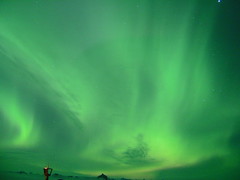
I've only seen an aurora once, and it was an Aurora Australis. I was at only 32.7 degrees south latitude, in South Australia -- very far north to see them. They oscillated and shimmered like a bright green gossamer curtain. I hope to see the Aurora Borealis this coming spring, when I'll be in Alaska.

(Photo in the creative commons by Chantal Steyn.)

Friday, October 16, 2009

Look! Up in the sky! It's a bird! It's a plane!

It's the moon! It's meteors!


Pretty much everyone knows that I have a broad definition of "geography," right? Usually, if I can see it from earth, or if what happens there is directly relevant to earth, I'll often decide it counts. For awhile, I pondered having a day a week set aside for related sciences, but I've mostly given that up. If I post them here, I'll find a way to make them geography-relevant.

But this trailer is about an event that involves people on the ground looking at things relatively close to us, including within our atmosphere, so I think it's all about geography. Check it out. It's a lot of fun.

Saturday, August 22, 2009

ah, for the wide open skies

I grew up under stars like this, but now I live in the city, and I live in a city that gets marine layer fog many nights all summer. An onshore breeze brings the low clouds in around 4 or 5 pm, and they go out again the next morning, but we can't ever count on seeing the sky.

Next spring, I think, I want to go up to Northern California -- the northeastern corner, Modoc County, and camp for a few days, and watch the Milky Way move like this:

Wednesday, August 12, 2009

white-hot meteors

An amateur astronomer set up his basic little digital camera to record some of the Perseid meteors last night:


The fog came in for us, and we saw none. This is the San Francisco Bay Area, where fog on summer nights keeps us cooler in the daytime, but makes star watching a real pain sometimes.

This little video makes me want to go somewhere more remote and clear, next August, and set up the camera with the 16 gb card in it, then drink hot cocoa and watch the skies.

Saturday, July 18, 2009

Thursday, July 02, 2009

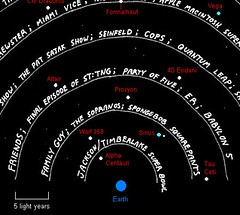
Alpha Centauri can finally see Janet Jackson's nipple


electromagnetic_leak
Originally uploaded by marymactavish.
The Abstruse Goose comic illustrates where the electromagnetic waves we're flung into space are now.

Sadly, folks on the furthest planets haven't yet seen Gilligan's Island. (I assume this means that Thermians come from somewhere near Formalhaut.)

(The big version's back at Abstruse Goose. It'll take you out past Aldeberan.)


(edited to add: This post led to a huge discussion in my house about how long the Thermians would have been able to see our TV shows, how long it took to build the ship, and whether they might have sent probes nearer to us to collect data, then had them return via hyperspace, faster than light, meaning that they would have more information from our TV shows than we realize.)

Wednesday, June 24, 2009

stretching the bounds of geographilia

I know this blog is about geography. Every so often I grumble about what the outside edges of "geography" are. It's a broad subject, indeed. Human geography is huge and vague around the edges, physical geography is only slightly more concrete. I love the range of the science.

It really doesn't include astronomy, and I battle with that in my brain, because astronomy fascinates me too.

Steph gets around it with her blog title, Adventures in Earth and Space, as she's a geologist who works with NASA.

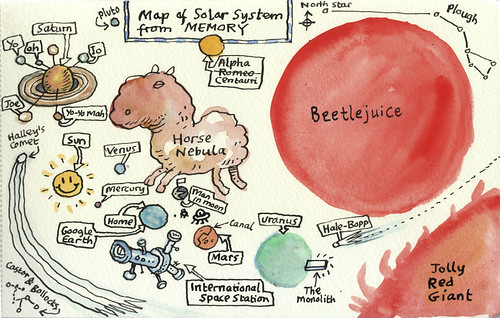
I throw up my hands here, I don't care, because I want to share with you these children's drawings:


Astronomy des petites - Kids' astronomy


I do not promise I will never say anything about astronomy again.

(click through the photo to see the whole set on flickr)

Friday, February 27, 2009

holy writing from my religion

At least, it's spiritual for me:

Poets say science takes away from the beauty of the stars -- mere globs of gas atoms.
I too can see the stars on a desert night, and feel them. But do I see less or more?
The vastness of the heavens stretches my imagination --
stuck on this carousel my little eye can catch one million year old light.
A vast pattern -- of which I am a part...
What is the pattern, or the meaning, or the why?
It does not do harm to the mystery to know a little about it.
For far more marvelous is the truth than any artists of the past imagined it.
Why do the poets of the present not speak of it?
What men are poets who can speak of Jupiter if he were a man, but if he is an immense spinning sphere of methane and ammonia
must be silent?
This was a footnote in one of physicist Richard Feynman's books, The Feynman Lectures on Physics. It's become one of my favorite poems ever.


(And I'm being a little silly, I don't really have science/nature/wonder as a religion, so much as that it's just a major source for things spiritual in my heart.)

Wednesday, February 18, 2009

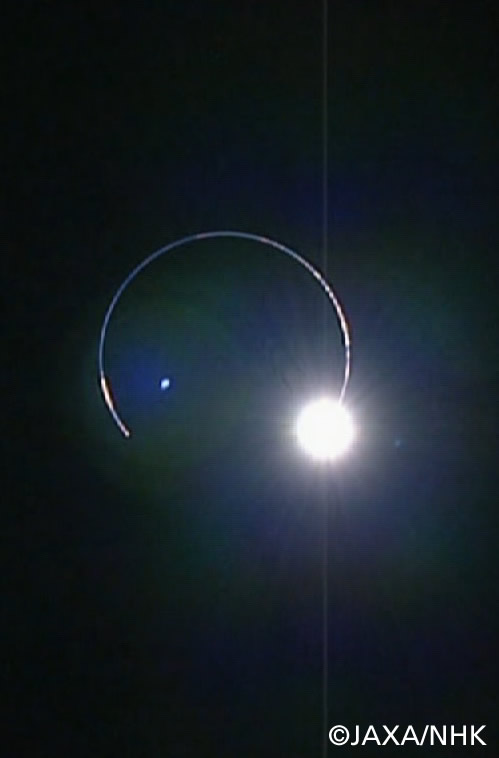
solar eclipse from the moon

This photo was taken from a craft orbiting the moon, while the earth was between the moon (or at least the orbiting craft) and the sun. http://spacefellowship.com/News/?p=8229. WOW. People on earth would be seeing some degree of lunar eclipse, this says a penumbral eclipse. It's one thing to picture this, but it's gorgeous to see it.


http://www.kaguya.jaxa.jp/en/communication/com_information_e.htm#NEW_20090218A


(After I originally posted this, my husband pointed out a simple oversight on my part -- From the moon, this would be a solar eclipse, as the earth is occulting the sun. Were the people orbiting the moon seeing the moon's shadow on the earth, with the sun behind, that would be a terrestrial eclipse.)

Thursday, July 24, 2008

One third of the way to the moon -- wow


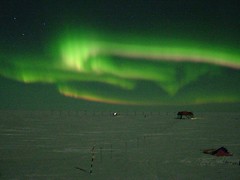
Aurora australis
Originally uploaded by Antarctic M.
Years ago, when I was an exchange student in rural Australia, my host mother woke me in the wee hours, one night, to bring me into the back yard. She pointed off to the south. The sky was full of light, a shimmering green gauze shower curtain, it seemed, billowing in the steam and air currents of the night sky. "This is unusually far north for it," she said, and it was, at about 32 degrees south of the equator.

The aurorae have been mysterious to humans throughout history, but we're learning more -- and the learning doesn't ruin the magic, for me. It reminds me of Richard Feynman's famous footnote within the Feynman Lectures on Physics. It reads like a poem:

Poets say science takes away from the beauty of the stars — mere globs of gas atoms. Nothing is 'mere'. I too can see the stars on a desert night, and feel them. But do I see less or more? The vastness of the heavens stretches my imagination— stuck on this carousel my little eye can catch one-million-year-old light. A vast pattern— of which I am a part... What is the pattern or the meaning or the why? It does not do harm to the mystery to know a little more about it. For far more marvelous is the truth than any artists of the past imagined it. Why do the poets of the present not speak of it? What men are poets who can speak of Jupiter if he were a man, but if he is an immense spinning sphere of methane and ammonia must be silent.


From a NASA press release:

NASA Satellites Discover What Powers Northern Lights

GREENBELT, Md. — Researchers using a fleet of five NASA satellites have discovered that explosions of magnetic energy a third of the way to the moon power substorms that cause sudden brightenings and rapid movements of the aurora borealis, called the Northern Lights.
The culprit turns out to be magnetic reconnection, a common process that occurs throughout the universe when stressed magnetic field lines suddenly snap to a new shape, like a rubber band that's been stretched too far.

"We discovered what makes the Northern Lights dance," said Dr. Vassilis Angelopoulos of the University of California, Los Angeles. Angelopoulos is the principal investigator for the Time History of Events and Macroscale Interactions during Substorms mission, or THEMIS.

Substorms produce dynamic changes in the auroral displays seen near Earth's northern and southern magnetic poles, causing a burst of light and movement in the Northern and Southern Lights.

Substorms often accompany intense space storms that can disrupt radio communications and global positioning system signals and cause power outages. Solving the mystery of where, when, and how substorms occur will allow scientists to construct more realistic substorm models and better predict a magnetic storm's intensity and effects.

"As they capture and store energy from the solar wind, the Earth's magnetic field lines stretch far out into space. Magnetic reconnection releases the energy stored within these stretched magnetic field lines, flinging charged particles back toward the Earth's atmosphere," said David Sibeck, THEMIS project scientist at NASA's Goddard Space Flight Center in Greenbelt, Md. "They create halos of shimmering aurora circling the northern and southern poles."

Scientists directly observe the beginning of substorms using five THEMIS satellites and a network of 20 ground observatories located throughout Canada and Alaska. Launched in February 2007, the five identical satellites line up once every four days along the equator and take observations synchronized with the ground observatories. Each ground station uses a magnetometer and a camera pointed upward to determine where and when an auroral substorm will begin. Instruments measure the auroral light from particles flowing along Earth's magnetic field and the electrical currents these particles generate.

During each alignment, the satellites capture data that allow scientists to precisely pinpoint where, when, and how substorms measured on the ground develop in space. On Feb. 26, 2008, during one such THEMIS lineup, the satellites observed an isolated substorm begin in space, while the ground-based observatories recorded the intense auroral brightening and space currents over North America.

These observations confirm for the first time that magnetic reconnection triggers the onset of substorms. The discovery supports the reconnection model of substorms, which asserts a substorm starting to occur follows a particular pattern. This pattern consists of a period of reconnection, followed by rapid auroral brightening and rapid expansion of the aurora toward the poles. This culminates in a redistribution of the electrical currents flowing in space around Earth.

THEMIS is the fifth medium-class mission under NASA's Explorer Program. The program, managed by the Explorers Program Office at Goddard provides frequent flight opportunities for world-class space investigations in heliophysics and astrophysics. The University of California, Berkeley's Space Sciences Laboratory in Berkeley, Calif., managed the project development and is currently operating the THEMIS mission. ATK Space (formerly Swales Aerospace) of Beltsville, Md., built the THEMIS satellites.

The THEMIS team's findings will appear online July 24 in Science Express and Aug. 14 in the journal science. For more information about the THEMIS mission, visit:

http://www.nasa.gov/themis


Gizmodo has a great animation of the bursts of energy related to the aurora.
NASA has a wealth of other videos.